

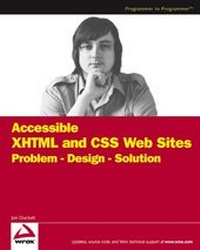
Accessible XHTML and CSS Web Sites
Problem - Design - Solution
1st Edition
Published on 15. April 2005
Book
Paperback/Softback
480 pages
978-0-7645-8306-3 (ISBN)
Description
* Shows Web developers how to make the transition from HTML to XHTML, an XML-based reformulation of HTML that offers greater design flexibility
* Demonstrates how to work with CSS (Cascading Style Sheets)-now supported by ninety percent of browsers and integral to new site-building tools from Macromedia and others-and implement a consistent style throughout and entire site
* Explains how to make a site accessible to people with impaired vision, limited hand use, dyslexia, and other issues-now a legal requirement for many sites in the U.S. and the U.K.
* Demonstrates how to work with CSS (Cascading Style Sheets)-now supported by ninety percent of browsers and integral to new site-building tools from Macromedia and others-and implement a consistent style throughout and entire site
* Explains how to make a site accessible to people with impaired vision, limited hand use, dyslexia, and other issues-now a legal requirement for many sites in the U.S. and the U.K.
More details
Edition
1., Auflage
Language
English
Place of publication
Foster City
United States
Publishing group
John Wiley & Sons Inc
Target group
Professional and scholarly
Illustrations
Illustrations
Dimensions
Height: 23.5 cm
Width: 18.9 cm
Thickness: 25 mm
Weight
710 gr
ISBN-13
978-0-7645-8306-3 (9780764583063)
Schweitzer Classification
Other editions
Additional editions
E-Book
04/2005
Wrox
€26.99
Available for download
Person
Jon Duckett published his first Web site in 1996 while studying for a BSc (Hons) in psychology at Brunel University, London. Since then he has helped create a wide variety of Web sites and has coauthored more than ten programming-related books on topics from ASP to XML (via many other letters of the alphabet) that have covered diverse aspects of Web programming, including design, architecture, and coding.
After graduating, Jon worked for Wrox Press, first in their Birmingham (U.K.) offices for three years and then in Sydney (Australia) for another year. He is now a freelance developer and consultant based in a leafy suburb of London, working for a range of clients spread across three continents.
When not stuck in front of a computer screen, Jon enjoys writing and listening to music.
After graduating, Jon worked for Wrox Press, first in their Birmingham (U.K.) offices for three years and then in Sydney (Australia) for another year. He is now a freelance developer and consultant based in a leafy suburb of London, working for a range of clients spread across three continents.
When not stuck in front of a computer screen, Jon enjoys writing and listening to music.
Content
Preface.
Introduction.
Chapter 1: Introducing the Site.
Chapter 2: Moving from HTML to XHTML.
Chapter 3: Using CSS to Style Documents.
Chapter 4: Adding More Style with CSS.
Chapter 5: Using CSS for Layout.
Chapter 6: Understanding Accessibility.
Chapter 7: Creating Accessible Tables and Forms and Testing Your Site.
Chapter 8: Looking to the Future.
Appendix A: Final Example Code.
Appendix B: XHTML Element Reference.
Appendix C: CSS Properties.
Appendix D: Escape Characters.
Appendix E: MIME Types.
Index.
Introduction.
Chapter 1: Introducing the Site.
Chapter 2: Moving from HTML to XHTML.
Chapter 3: Using CSS to Style Documents.
Chapter 4: Adding More Style with CSS.
Chapter 5: Using CSS for Layout.
Chapter 6: Understanding Accessibility.
Chapter 7: Creating Accessible Tables and Forms and Testing Your Site.
Chapter 8: Looking to the Future.
Appendix A: Final Example Code.
Appendix B: XHTML Element Reference.
Appendix C: CSS Properties.
Appendix D: Escape Characters.
Appendix E: MIME Types.
Index.