

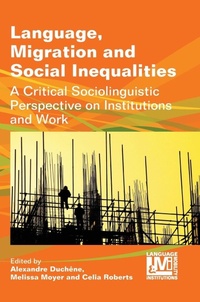
Language, Migration and Social Inequalities
A Critical Sociolinguistic Perspective on Institutions and Work
Published on 12. November 2013
Book
Hardback
296 pages
978-1-78309-100-3 (ISBN)
Description
Migration and the mobility of citizens around the globe pose important challenges to the linguistic and cultural homogeneity that nation-states rely on for defining their physical boundaries and identity, as well as the rights and obligations of their citizens. A new social order resulting from neoliberal economic practices, globalisation and outsourcing also challenges traditional ways the nation-state has organized its control over the people who have typically travelled to a new country looking for work or better life chances. This collection provides an account of the ways language addresses core questions concerning power and the place of migrants in various institutional and workplace settings. It brings together contributions from a range of geographical settings to understand better how linguistic inequality is (re)produced in this new economic order.
Reviews / Votes
This stimulating volume brings together classic strands of critical sociolinguistic work on how immigrants are disadvantaged in social gatekeeping institutions and the contemporary sociolinguistics of globalization. Taking a broad view of 'migrants' as sociolinguistically mobile citizens, the authors mobilize an impressive array of ideological, political and economic frameworks to explore the continuing power of institutions to confer and withhold status and opportunity as well as forms of resistance to these processes. -- Alexandra Jaffe, California State University, Long Beach, USA This major sociolinguistic contribution, with its wide-ranging and detailed ethnographic attention to the structures shaping migrant experiences of language, sheds innovative analytic light on the neoliberal regimentation of language at work, in school, and in bureaucratic processes, the commodification of language skills, and the contradictions of contemporary capitalism that shape linguistic practices and ideologies. -- Bonnie Urciuoli, Hamilton College, USA This book does a wonderful job of focusing critically on the sociolinguistics of migrant workers - the protagonists of the book - in various institutions and workplaces (or their exclusion from them). From the informal locutorios of Barcelona and Congolese la debrouille in Cape Town, to the decapitalisation of migrant students in Madrid schools and the mismatched aspirations and actual work of Japanese flight attendants, these studies focus both on local migrant sociolinguistics as well as wider social and economic orders. Making questions of the (re)production of linguistic, social and economic disparities central, this book thus provides vital insights into language, mobility and inequality. -- Alastair Pennycook, University of Technology, Sydney, Australia This book contains a wealth of good scholarship and revealing critical analyses of the local ways in which social inequality is produced or contested. Each of the contributions has been very well written and the authors show a sincere commitment to learning how language issues affect people's life chances. -- Joan Pujolar, Universitat Oberta de Catalunya, Spain * Journal of Sociolinguistics, 2015-2016 (Volumes 19-20) *More details
Series
Language
English
Place of publication
Bristol
United Kingdom
Publishing group
Channel View Publications Ltd
Target group
Professional and scholarly
Dimensions
Height: 216 mm
Width: 153 mm
Thickness: 20 mm
Weight
496 gr
ISBN-13
978-1-78309-100-3 (9781783091003)
Copyright in bibliographic data and cover images is held by Nielsen Book Services Limited or by the publishers or by their respective licensors: all rights reserved.
Schweitzer Classification
Other editions
Additional editions
Alexandre Duchene | Melissa Moyer Greer | Celia Roberts
Language, Migration and Social Inequalities
A Critical Sociolinguistic Perspective on Institutions and Work
Book
11/2013
Multilingual Matters
€48.20
Shipment within 10-20 days
Persons
Alexandre Duchene is Professor of Sociolinguistics at the University of Fribourg and Director of the Institute of Multilingualism of the University and HEP Fribourg (Switzerland). Recent publications include Ideologies across Nations (2008), Discourses of Endangerment (with Monica Heller, 2007) and Language in Late Capitalism: Pride and Profit (with Monica Heller, 2011).
Melissa Moyer is Professor of English Linguistics at the Universitat Autonoma de Barcelona, Spain, where she leads the C.I.E.N. Research Team. Her current research is concerned with multilingualism and mobility in connection to linguistic practices and the construction of identity. She was editor of The Blackwell Guide to Research Methods in Bilingualism and Multilingualism (2008, with Li Wei).
Celia Roberts is Professor of Applied Linguistics at King's College London, UK in the Centre for Language, Discourse and Communication. Her publications include Talk, Work and Institutional Order (1999, with Srikant Sarangi). Her main interest is in the practical relevance and application of sociolinguistics to real world problems.
Melissa Moyer is Professor of English Linguistics at the Universitat Autonoma de Barcelona, Spain, where she leads the C.I.E.N. Research Team. Her current research is concerned with multilingualism and mobility in connection to linguistic practices and the construction of identity. She was editor of The Blackwell Guide to Research Methods in Bilingualism and Multilingualism (2008, with Li Wei).
Celia Roberts is Professor of Applied Linguistics at King's College London, UK in the Centre for Language, Discourse and Communication. Her publications include Talk, Work and Institutional Order (1999, with Srikant Sarangi). Her main interest is in the practical relevance and application of sociolinguistics to real world problems.
Content
1. Alexandre Duchene, Melissa Moyer & Celia Roberts: Introduction: Recasting Institutions and Work in Multilingual and Transnational Spaces
Part I: Sites of Control
2. Eva Codo: Trade Unions and NGOs under Neoliberalism: Between Regimenting Migrants and Subverting the State
3. Kori Allan: Skilling the Self: The Communicability of Immigrants as Flexible Labour
Part II: Sites of Selection
4. Celia Roberts: The Gatekeeping of Babel: Job Interviews and the Linguistic Penalty
5. Ingrid Piller & Kimie Takahashi: Language Work aboard the Low-Cost Airline
6. Luisa Martin Rojo: (De) Capitalising Students through Linguistic Practices. A Comparative Analysis of New Educational Programmes in a Global Era
7. Vally Lytra: From Kebabci to Professional: The Commodification of Language and Social Mobility in Turkish Complementary Schools in the UK
Part III: Sites of Resistance
8. Werner Holly & Ulrike Hanna Meinhof: 'Integration hatten wir letztes jahr.' Official Discourses of Integration and their Uptake by Migrants in Germany
9. Melissa G. Moyer: Language as a Resource. Migrant Agency, Positioning and Resistance in a Health Care Clinic
10. Cecile B. Vigouroux: Informal Economy and Language Practice in the Context of Migrations
11. Maria Sabate i Dalmau: Fighting Exclusion from the Margins: Locutorios as Sites of Social Agency and Resistance for Migrants
Mike Baynham: Postscript
Contributors
Part I: Sites of Control
2. Eva Codo: Trade Unions and NGOs under Neoliberalism: Between Regimenting Migrants and Subverting the State
3. Kori Allan: Skilling the Self: The Communicability of Immigrants as Flexible Labour
Part II: Sites of Selection
4. Celia Roberts: The Gatekeeping of Babel: Job Interviews and the Linguistic Penalty
5. Ingrid Piller & Kimie Takahashi: Language Work aboard the Low-Cost Airline
6. Luisa Martin Rojo: (De) Capitalising Students through Linguistic Practices. A Comparative Analysis of New Educational Programmes in a Global Era
7. Vally Lytra: From Kebabci to Professional: The Commodification of Language and Social Mobility in Turkish Complementary Schools in the UK
Part III: Sites of Resistance
8. Werner Holly & Ulrike Hanna Meinhof: 'Integration hatten wir letztes jahr.' Official Discourses of Integration and their Uptake by Migrants in Germany
9. Melissa G. Moyer: Language as a Resource. Migrant Agency, Positioning and Resistance in a Health Care Clinic
10. Cecile B. Vigouroux: Informal Economy and Language Practice in the Context of Migrations
11. Maria Sabate i Dalmau: Fighting Exclusion from the Margins: Locutorios as Sites of Social Agency and Resistance for Migrants
Mike Baynham: Postscript
Contributors