

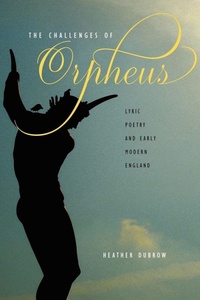
The Challenges of Orpheus
Lyric Poetry and Early Modern England
Will be published approx. on 10. August 2011
Book
Paperback/Softback
304 pages
978-1-4214-0042-6 (ISBN)
Description
As a literary mode "lyric" is difficult to define precisely. While the term has conventionally been applied to brief, songlike poems expressing the speaker's interior thoughts critics have questioned many of the assumptions underlying this definition, calling into doubt the very possibility of self-expression in language. Whereas much recent scholarship on lyric has centered on the Romantic era, Heather Dubrow turns instead to the poetry of early modern England. The Challenges of Orpheus confronts widespread assumptions about lyric, exploring such topics as its relationship to its audiences, the impact of material conditions of production and other cultural pressures, lyric's negotiations of gender, and the interactions and tensions between lyric and narrative. Offering fresh perspectives on major texts of the period-from Wyatt's "My lute awake" to Milton's Nativity Ode-as well as poems by lesser-known figures, Dubrow extends her critical conclusions to poetry in other historical periods and to the relationship between creative writers and critics, recommending new directions for the study of lyric and of genre.
Reviews / Votes
Thorough, penetrating, and on the cutting edge of contemporary scholarship. Essential. Choice 2008 A useful and detailed study. Dubrow is especially good at analysing the relationship between gender and genre. Times Literary Supplement 2008 Her refinement of generic oppositions... leads to some striking juxtapositions as well as-to my thinking at least-an exceptionally interesting discussion of the status and function of song in Shakespearean drama. Huntington Library Quarterly 2008 Dubrow accomplishes much in this pioneering study. Studies in English Literature Formidable exegetical skills... Dubrow's terse accounts bring great insight and illumination to the problem of defining and describing lyric poetry. Clio 2008 Includes some of her most important thinking to date about issues that are central to the study of lyric poetry in any period. Seventeenth Century News 2009 A study that is itself both challenging and gentle-in all the very best senses of that word. -- Christopher Martin Sixteenth Century Journal 2009 Her study exemplifies an ideal of informed and judicious close reading that one can only hope will prove as infectious as its author wishes it to be. -- Elizabeth Heale Modern Language Review 2009 Represents both a wide-ranging exploration of lyric poetry in the early modern period and a plea for scholars to emphasize multivalent ideas and inclusive taxonomies over hierarchical and sharply argumentative approaches. Year's Work in English Studies 2010More details
Language
English
Place of publication
Baltimore, MD
United States
Target group
Professional and scholarly
Product notice
Paperback (trade)
Dimensions
Height: 229 mm
Width: 152 mm
Thickness: 18 mm
Weight
496 gr
ISBN-13
978-1-4214-0042-6 (9781421400426)
DOI
10.1353/book.20655
Copyright in bibliographic data and cover images is held by Nielsen Book Services Limited or by the publishers or by their respective licensors: all rights reserved.
Schweitzer Classification
Other editions
Additional editions
Book
03/2008
Johns Hopkins University Press
€76.33
Article exhausted; check different version
E-Book
03/2008
Johns Hopkins University Press
€24.99
Available for download
Person
Heather Dubrow is the John D. Boyd, S.J., Chair in the Poetic Imagination at Fordham University.
Content
Acknowledgments
Introduction
1. The Rhetoric of Lyric: Definitions, Descriptions, Disputations
2. The Domain of Echo: Lyric Audiences
3. The Craft of Pygmalion: Immediacy and Distancing
4. The Predilections of Proteus: Size and Structure
5. The Myth of Janus: Lyric and/or Narrative
6. The Rhetorics of Lyric: Conclusions and New Perspectives
Notes
Index
Introduction
1. The Rhetoric of Lyric: Definitions, Descriptions, Disputations
2. The Domain of Echo: Lyric Audiences
3. The Craft of Pygmalion: Immediacy and Distancing
4. The Predilections of Proteus: Size and Structure
5. The Myth of Janus: Lyric and/or Narrative
6. The Rhetorics of Lyric: Conclusions and New Perspectives
Notes
Index