

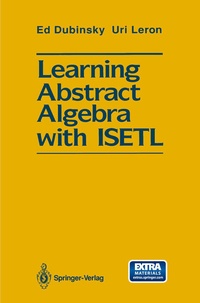
Learning Abstract Algebra with ISETL
Published on 28. February 2014
Book
Paperback/Softback
XXI, 257 pages
978-1-4612-7610-4 (ISBN)
Description
This book is based on the belief that, before students can make sense of any presentation of abstract mathematics, they need to be engaged in mental activities that will establish an experiential base for any future verbal explanations and to have the opportunity to reflect on their activities. This approach is based on extensive theoretical and empirical studies, as well as on the substantial experience of the authors in teaching Abstract Algebra. The main source of activities in this course is computer constructions, specifically, small programs written in the math-like programming language ISETL; the main tool for reflection is work in teams of two to four students, where the activities are discussed and debated. Because of the similarity of ISETL expressions to standard written mathematics, there is very little programming overhead: learning to program is inseparable from learning the mathematics. Each topic is first introduced through computer activities, which are then followed by a text section and exercises. The text section is written in an informal, discursive style, closely relating definitions and proofs to the constructions in the activities. Notions such as cosets and quotient groups become much more meaningful to the students than when they are presented in a lecture.
More details
Edition
Softcover reprint of the original 1st ed. 1994
Language
English
Place of publication
New York
United States
Target group
Professional and scholarly
Professional/practitioner
Illustrations
XXI, 257 p.
Dimensions
Height: 235 mm
Width: 155 mm
Thickness: 16 mm
Weight
435 gr
ISBN-13
978-1-4612-7610-4 (9781461276104)
DOI
10.1007/978-1-4612-2620-8
Schweitzer Classification
Other editions
Additional editions
Ed Dubinsky | Uri Leron
Learning Abstract Algebra with ISETL
Book
12/1993
Springer
€87.00
Article not available at the moment
Content
1 Mathematical Constructions in ISETL.- 1.1 Using ISETL.- 1.2 Compound objects and operations on them.- 1.3 Functions in ISETL.- 2 Groups.- 2.1 Getting acquainted with groups.- 2.2 The modular groups and the symmetric groups.- 2.3 Properties of groups.- 3 Subgroups.- 3.1 Definitions and examples.- 3.2 Cyclic groups and their subgroups.- 3.3 Lagrange's theorem.- 4 The Fundamental Homomorphism Theorem.- 4.1 Quotient groups.- 4.2 Homomorphisms.- 4.3 The homomorphism theorem.- 5 Rings.- 5.1 Rings.- 5.2 Ideals.- 5.3 Homomorphisms and isomorphisms.- 6 Factorization in Integral Domains.- 6.1 Divisibility properties of integers and polynomials.- 6.2 Euclidean domains and unique factorization.- 6.3 The ring of polynomials over a field.