

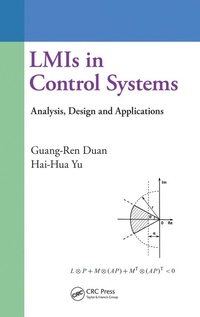
LMIs in Control Systems
Analysis, Design and Applications
1st Edition
Published on 17. June 2013
Book
Hardback
483 pages
978-1-4665-8299-6 (ISBN)
Description
Although LMI has emerged as a powerful tool with applications across the major domains of systems and control, there has been a need for a textbook that provides an accessible introduction to LMIs in control systems analysis and design. Filling this need, LMIs in Control Systems: Analysis, Design and Applications focuses on the basic analysis and design problems of both continuous- and discrete-time linear systems based on LMI methods.
Providing a broad and systematic introduction to the rich content of LMI-based control systems analysis and design with applications, this book is suitable for use as a textbook for LMI related courses for senior undergraduate and postgraduate students in the fields of control systems theory and applications.
Key Features:
Contains four well-structured parts: Preliminaries, Control Systems Analysis, Control Systems Design, and Applications, as well as an introduction chapter and two appendices
Summarizes most of the technical lemmas used in the book in one preliminary chapter, and classifies them systematically into different groups
Includes many examples, exercises, and practical application backgrounds
Summarizes most of the important results in the last section of each chapter, in a clear table format
Contains an application part composed of two chapters that respectively deal with missile and satellite attitude control using LMI techniques
Provides a brief and clear introduction to the use of the LMI Lab in the MATLAB (R) Robust Control Toolbox
Supplies detailed proofs for all main results, with lengthy ones clearly divided into different subsections or steps-using elementary mathematics whenever possible
Uses a pole assignment Benchmark problem, in support of the numerical reliability of LMI techniques, where numerical unreliability could result in a solution to a problem that is far from the true one
A Solutions Manual and MATLAB (R) codes for the computational exercise problems and examples are available upon qualified course adoption.
Providing a broad and systematic introduction to the rich content of LMI-based control systems analysis and design with applications, this book is suitable for use as a textbook for LMI related courses for senior undergraduate and postgraduate students in the fields of control systems theory and applications.
Key Features:
Contains four well-structured parts: Preliminaries, Control Systems Analysis, Control Systems Design, and Applications, as well as an introduction chapter and two appendices
Summarizes most of the technical lemmas used in the book in one preliminary chapter, and classifies them systematically into different groups
Includes many examples, exercises, and practical application backgrounds
Summarizes most of the important results in the last section of each chapter, in a clear table format
Contains an application part composed of two chapters that respectively deal with missile and satellite attitude control using LMI techniques
Provides a brief and clear introduction to the use of the LMI Lab in the MATLAB (R) Robust Control Toolbox
Supplies detailed proofs for all main results, with lengthy ones clearly divided into different subsections or steps-using elementary mathematics whenever possible
Uses a pole assignment Benchmark problem, in support of the numerical reliability of LMI techniques, where numerical unreliability could result in a solution to a problem that is far from the true one
A Solutions Manual and MATLAB (R) codes for the computational exercise problems and examples are available upon qualified course adoption.
Reviews / Votes
LMIs play the same central role in the postmodern theory as Lyapunov and Riccati equations played in the modern, and in turn various graphical techniques such as Bode, Nyquist, and Nichols plots played in the classical.-J. Doyle, A. Packet, and K. M. ZhouMore details
Language
English
Place of publication
Bosa Roca
United States
Publishing group
Taylor & Francis Inc
Target group
College/higher education
Illustrations
53 s/w Abbildungen, 29 s/w Tabellen
29 Tables, black and white; 53 Illustrations, black and white
Dimensions
Height: 240 mm
Width: 161 mm
Thickness: 30 mm
Weight
886 gr
ISBN-13
978-1-4665-8299-6 (9781466582996)
Copyright in bibliographic data and cover images is held by Nielsen Book Services Limited or by the publishers or by their respective licensors: all rights reserved.
Schweitzer Classification
Other editions
Additional editions
E-Book
06/2013
1st Edition
CRC Press
€158.99
Available for download
E-Book
06/2013
CRC Press
€158.99
Available for download
Persons
Guang-Ren Duan received his BSc. degree in Applied Mathematics, and both his MSc and PhD degrees in Control Systems Theory. From 1989 to 1991, he was a post-doctoral researcher at Harbin Institute of Technology, where he became full professor of control systems theory in the end of 1991. Prof. Duan visited the University of Hull, UK, and the University of Sheffield, UK from December 1996 to October 1998, and worked as a lecturer at the Queen's University of Belfast, UK from October 1998 to October 2002. Since August 2000, he has been elected Specially Employed Professor at Harbin Institute of Technology sponsored by the Cheung Kong Scholars Program of the Chinese government. He is currently the Director of the Center for Control Theory and Guidance Technology at Harbin Institute of Technology.
He is the author and co-author of 3 books and more than 180 SCI indexed publications. Particularly, he has published with Springer a book entitled Analysis and Design of Descriptor Linear Systems, and has published over 30 papers in IEEE Transactions. His main research interests include parametric robust control systems design, LMI-based control systems analysis and design, descriptor systems, flight control and magnetic bearing control.
He has taught quite a few courses both at Harbin Institute of Technology, China, and at the Queen's University of Belfast, UK. Particularly, he has lectured at Harbin Institute of Technology the graduate course "Linear Matrix Inequalities in Control Systems Analysis and Design", based on this set of lecture notes.
He is the author and co-author of 3 books and more than 180 SCI indexed publications. Particularly, he has published with Springer a book entitled Analysis and Design of Descriptor Linear Systems, and has published over 30 papers in IEEE Transactions. His main research interests include parametric robust control systems design, LMI-based control systems analysis and design, descriptor systems, flight control and magnetic bearing control.
He has taught quite a few courses both at Harbin Institute of Technology, China, and at the Queen's University of Belfast, UK. Particularly, he has lectured at Harbin Institute of Technology the graduate course "Linear Matrix Inequalities in Control Systems Analysis and Design", based on this set of lecture notes.
Content
Introduction. Preliminaries. Technical Lemmas. Review of Optimization Theory. Control Systems Analysis. Stability Analysis. H?/H2 Performance. Property Analysis. Control Systems Design. Feedback Stabilization. H?/H2 Control. State Observation and Filtering. Multiple Objective Designs. Applications. Missile Attitude Control. Satellite Control. Appendices.