

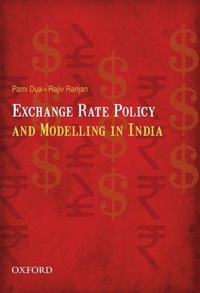
Exchange Rate Policy and Modelling in India
1st Edition
Published in December 2012
Book
Hardback
272 pages
978-0-19-807720-6 (ISBN)
Description
Exchange rate fluctuations affect the value of international investment portfolios, competitiveness of exports and imports, value of international reserves, currency value of debt payments, and the cost to tourists in terms of the value of their currency. Movements in exchange rates, therefore, have significant implications for the economy's business cycle, trade, and capital flows. This book provides a comprehensive analysis of the foreign exchange market in India in terms of participants, instruments and the trading platform, as also turnover and forward premia.
The book covers four broad areas: (i) various facets of economic policy with respect to the exchange rate; (ii) the recent global financial crisis and the role of exchange rates therein; (iii) the pattern of capital flows and capital account liberalization; and (iv) modelling and forecasting the exchange rate. The authors contextualize the evolution of the Indian foreign exchange market from a highly regulated market to a deep, liquid, and efficient market in the 1990s, and focus on how large capital flows have impacted the exchange rate policy. More important, they develop a model for the rupee-dollar exchange rate taking into account variables from monetary and micro structure models as well as other variables such as central bank intervention.
The book covers four broad areas: (i) various facets of economic policy with respect to the exchange rate; (ii) the recent global financial crisis and the role of exchange rates therein; (iii) the pattern of capital flows and capital account liberalization; and (iv) modelling and forecasting the exchange rate. The authors contextualize the evolution of the Indian foreign exchange market from a highly regulated market to a deep, liquid, and efficient market in the 1990s, and focus on how large capital flows have impacted the exchange rate policy. More important, they develop a model for the rupee-dollar exchange rate taking into account variables from monetary and micro structure models as well as other variables such as central bank intervention.
More details
Language
English
Place of publication
New Delhi
India
Target group
College/higher education
Professional and scholarly
Undergraduate and postgraduate students and scholars of international economics, particularly international trade and finance, as well as bankers, business analysts, and policymakers.
Product notice
sewn/stitched
Cloth over boards
With dust jacket
Dimensions
Height: 216 mm
Width: 142 mm
Thickness: 25 mm
Weight
431 gr
ISBN-13
978-0-19-807720-6 (9780198077206)
Copyright in bibliographic data and cover images is held by Nielsen Book Services Limited or by the publishers or by their respective licensors: all rights reserved.
Schweitzer Classification
Persons
Pami Dua is Professor and Head, Department of Economics, Delhi School of Economics, University of Delhi.
Rajiv Ranjan is Director, Department of Economic Analysis and Policy, Reserve Bank of India, Mumbai.
Rajiv Ranjan is Director, Department of Economic Analysis and Policy, Reserve Bank of India, Mumbai.
Content
1. Introduction ; 2. Exchange Rate Regimes ; 3. Exchange Rate and Exchange Rate Policy ; 4. Foreign Exchange Market Structure and Turnover ; 5. Manifestations of the Global Financial Crisis ; 6. Approach to Capital Account Liberalization ; 7. Capital Flows and Central Bank Intervention in the Foreign Exchange Market ; 8. Modelling and Forecasting the Exchange Rate ; 9. Concluding Observations ; ANNEXURE ; DATA DEFINITION AND SOURCES ; REFERENCES ; INDEX