

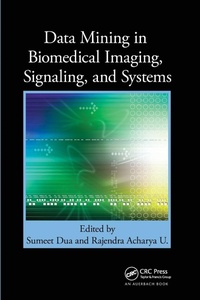
Data Mining in Biomedical Imaging, Signaling, and Systems
1st Edition
Published on 19. September 2019
Book
Paperback/Softback
440 pages
978-0-367-38277-3 (ISBN)
Description
Data mining can help pinpoint hidden information in medical data and accurately differentiate pathological from normal data. It can help to extract hidden features from patient groups and disease states and can aid in automated decision making. Data Mining in Biomedical Imaging, Signaling, and Systems provides an in-depth examination of the biomedical and clinical applications of data mining. It supplies examples of frequently encountered heterogeneous data modalities and details the applicability of data mining approaches used to address the computational challenges in analyzing complex data.
The book details feature extraction techniques and covers several critical feature descriptors. As machine learning is employed in many diagnostic applications, it covers the fundamentals, evaluation measures, and challenges of supervised and unsupervised learning methods. Both feature extraction and supervised learning are discussed as they apply to seizure-related patterns in epilepsy patients. Other specific disorders are also examined with regard to the value of data mining for refining clinical diagnoses, including depression and recurring migraines. The diagnosis and grading of the world's fourth most serious health threat, depression, and analysis of acoustic properties that can distinguish depressed speech from normal are also described. Although a migraine is a complex neurological disorder, the text demonstrates how metabonomics can be effectively applied to clinical practice.
The authors review alignment-based clustering approaches, techniques for automatic analysis of biofilm images, and applications of medical text mining, including text classification applied to medical reports. The identification and classification of two life-threatening heart abnormalities, arrhythmia and ischemia, are addressed, and a unique segmentation method for mining a 3-D imaging biomarker, exemplified by evaluation of osteoarthritis, is also present
The book details feature extraction techniques and covers several critical feature descriptors. As machine learning is employed in many diagnostic applications, it covers the fundamentals, evaluation measures, and challenges of supervised and unsupervised learning methods. Both feature extraction and supervised learning are discussed as they apply to seizure-related patterns in epilepsy patients. Other specific disorders are also examined with regard to the value of data mining for refining clinical diagnoses, including depression and recurring migraines. The diagnosis and grading of the world's fourth most serious health threat, depression, and analysis of acoustic properties that can distinguish depressed speech from normal are also described. Although a migraine is a complex neurological disorder, the text demonstrates how metabonomics can be effectively applied to clinical practice.
The authors review alignment-based clustering approaches, techniques for automatic analysis of biofilm images, and applications of medical text mining, including text classification applied to medical reports. The identification and classification of two life-threatening heart abnormalities, arrhythmia and ischemia, are addressed, and a unique segmentation method for mining a 3-D imaging biomarker, exemplified by evaluation of osteoarthritis, is also present
More details
Language
English
Place of publication
London
United Kingdom
Publishing group
Taylor & Francis Ltd
Target group
Professional and scholarly
Professional Practice & Development
Dimensions
Height: 234 mm
Width: 156 mm
Thickness: 24 mm
Weight
667 gr
ISBN-13
978-0-367-38277-3 (9780367382773)
Copyright in bibliographic data and cover images is held by Nielsen Book Services Limited or by the publishers or by their respective licensors: all rights reserved.
Schweitzer Classification
Other editions
Additional editions
Sumeet Dua | Rajendra Acharya U
Data Mining in Biomedical Imaging, Signaling, and Systems
E-Book
04/2016
1st Edition
Auerbach
€65.99
Available for download
Sumeet Dua | Rajendra Acharya U
Data Mining in Biomedical Imaging, Signaling, and Systems
E-Book
04/2016
1st Edition
Auerbach
€65.99
Available for download
Sumeet Dua | Rajendra Acharya U
Data Mining in Biomedical Imaging, Signaling, and Systems
Book
05/2011
1st Edition
Taylor & Francis
€187.50
Shipment within 15-20 days
Persons
Sumeet Dua, PhD, is currently an Upchurch endowed associate professor and the coordinator of IT research at Louisiana Tech University, Ruston. He also serves as adjunct faculty to the School of Medicine, Louisiana State University, Health Sciences Center in New Orleans. His areas of expertise include data mining, image processing, computational decision support, pattern recognition, data warehousing, biomedical informatics, and heterogeneous distributed data integration. The National Science Foundation (NSF), the National Institutes of Health (NIH), the Air Force Research Laboratory (AFRL), the Air Force Office of Sponsored Research, (AFOSR), and the Louisiana Board of Regents (LA-BoR) have funded his research. He frequently serves as a study section member (expert panelist) for the NIH's Center for Scientific Review and has served as a panelist for the NSF/Computing in Science in Engineering (CISE) Directorate. Dr. Dua has chaired several conference sessions in the area of data mining and bioinformatics, and is the program chair for the 5th International Conference on Information Systems, Technology, and Management (ICISTM-2011). He has given over 26 invited talks on data mining and bioinformatics at international academic and industry arenas, advised over 25 graduate theses, and currently advises several students in this field. Dr. Dua is acoinventor of two issued U.S. patents, has co-authored over 50 publications and book chapters, and is an author /editor of 4 books in data mining and bioinformatics.
Dr. Dua has received the Engineering and Science Foundation Award for Faculty Excellence (2006) and the Faculty Research Recognition Award (2007); he has been recognized as a Distinguished Researcher (2004-2010) by the Louisiana Biomedical Research Network (sponsored by NIH) and has won the Oustanding Poster Award at the NIH/National Cancer Institute (NCI) caBIG-NCRI Informatics Joint Conference; Biomedical Informatics wi
Dr. Dua has received the Engineering and Science Foundation Award for Faculty Excellence (2006) and the Faculty Research Recognition Award (2007); he has been recognized as a Distinguished Researcher (2004-2010) by the Louisiana Biomedical Research Network (sponsored by NIH) and has won the Oustanding Poster Award at the NIH/National Cancer Institute (NCI) caBIG-NCRI Informatics Joint Conference; Biomedical Informatics wi
Content
Data Mining of Acoustical Properties of Speech as Indicators of Depression. Artificial Neural Network Based ECG Arrhythmia Classification. Human Reflexive Response and its Objective Function Regarding Balance Recovery From Perturbation During Walking. Automatic Identification of Epileptic EEG Signals Using Nonlinear Parameters. Data Mining Approach to Classify the Pathological Images in Databases Using Color Image Analysis. Discovery of Association Among Diseases in the Upper Gastro Intestinal Tract Using Data Mining Techniques. Data Analysis Techniques Applied to Metabolomics: Analysis and Classification of Migraine Patterns. System Engineering Principles in the Design of Biomedical Systems. Feature Classification Methods for Knowledge Discovery in Mammograms. Mining of Imaging Biomarkers for Quantitative Evaluation of Osteosrthritis. Typicality Measure and the Creation of Predictive Models in Biomedicine. Automatic Segmentation Methods and Applications to Biofilm Image Analysis. On Clustering Gene Expression Time-Series Signals. Multi-Scale Method For Biomedical Image Segmentation.