

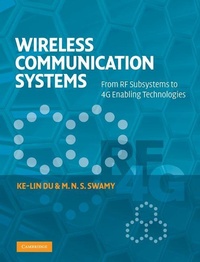
Wireless Communication Systems
From RF Subsystems to 4G Enabling Technologies
Published on 15. April 2010
Book
Hardback
1020 pages
978-0-521-11403-5 (ISBN)
Description
This practically-oriented, all-inclusive guide covers all the major enabling techniques for current and next-generation cellular communications and wireless networking systems. Technologies covered include CDMA, OFDM, UWB, turbo and LDPC coding, smart antennas, wireless ad hoc and sensor networks, MIMO, and cognitive radios, providing readers with everything they need to master wireless systems design in a single volume. Uniquely, a detailed introduction to the properties, design, and selection of RF subsystems and antennas is provided, giving readers a clear overview of the whole wireless system. It is also the first textbook to include a complete introduction to speech coders and video coders used in wireless systems. Richly illustrated with over 400 figures, and with a unique emphasis on practical and state-of-the-art techniques in system design, rather than on the mathematical foundations, this book is ideal for graduate students and researchers in wireless communications, as well as for wireless and telecom engineers.
More details
Language
English
Place of publication
Cambridge
United Kingdom
Target group
Professional and scholarly
Illustrations
Worked examples or Exercises; 24 Tables, unspecified; 4 Halftones, unspecified; 341 Line drawings, unspecified
Dimensions
Height: 250 mm
Width: 175 mm
Thickness: 59 mm
Weight
1900 gr
ISBN-13
978-0-521-11403-5 (9780521114035)
Copyright in bibliographic data and cover images is held by Nielsen Book Services Limited or by the publishers or by their respective licensors: all rights reserved.
Schweitzer Classification
Other editions
Additional editions
Ke-Lin Du | M. N. S. Swamy
Wireless Communication Systems
From RF Subsystems to 4G Enabling Technologies
E-Book
03/2011
1st Edition
Cambridge University Press
€85.99
Available for download
Persons
Content
1. Introduction; 2. An overview of wireless communications; 3. Channel and propagation; 4. Cellular and multiple-user systems; 5. Diversity; 6. Channel estimation and equalization; 7. Modulation and detection; 8. Spread spectrum communications; 9. Orthogonal frequency division multiplexing; 10. Antennas; 11. RF and microwave subsystems; 12. A/D and D/A conversions; 13. Signals and signal processing; 14. Fundamentals of information theory; 15. Channel coding; 16. Source coding I: speech and audio coding; 17. Source coding II: image and video coding; 18. Multiple antennas: smart antenna systems; 19. Multiple antennas: MIMO systems; 20. Ultra wideband communications; 22. Wireless ad hoc/sensor networks; The Q-function; Wirtinger calculus.