

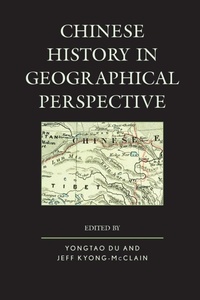
Chinese History in Geographical Perspective
Published on 27. February 2015
Book
Paperback/Softback
240 pages
978-1-4985-1092-9 (ISBN)
Description
The authors in this volume believe that long-term, profound, and sometimes tumultuous changes in the last five hundred years of the history of China have been no less geographical than social, political, or economic. From the dialectics of local-empire relations to the imperial state's persistent array of projects for absorbing and transforming ethnic regions on the margins of empire; from the tripling of imperial territories in the Qing to the disputes over the identity of the former "outer zones" in the early Republican era; and from the universalistic imagination of "all-under-heaven" to the fraught processes of re-drawing a new set of nation-state boundaries in the twentieth century, the study of the dynamics of geography, broadly conceived, promises to provide insight into the contested development of the geographical entity which we, today, call 'China.'
More details
Language
English
Place of publication
United States
Publishing group
Bloomsbury Publishing Plc
Target group
Professional and scholarly
Illustrations
36 BW Photos
Dimensions
Height: 229 mm
Width: 152 mm
Thickness: 14 mm
Weight
396 gr
ISBN-13
978-1-4985-1092-9 (9781498510929)
Copyright in bibliographic data and cover images is held by Nielsen Book Services Limited or by the publishers or by their respective licensors: all rights reserved.
Schweitzer Classification
Other editions
Additional editions
E-Book
01/2013
1st Edition
Lexington Books
€47.49
Available for download
Persons
Yongtao Du is Assistant Professor of Asian History at Oklahoma State University. His research interests include translocal practices in late imperial China and literati geographic consciousness in China during the Song through the Qing. He received a PhD in History from the University of Illinois at Urbana-Champaign in 2006.
Jeff Kyong-McClain is Assistant Professor of History at the University of Arkansas at Little Rock. His research explores the place of archeology in nation-building in modern China, Sino-Western interaction in China's borderlands, and urban transformations during the Republican era. He received his PhD in History from the University of Illinois at Urbana-Champaign in 2009.
Jeff Kyong-McClain is Assistant Professor of History at the University of Arkansas at Little Rock. His research explores the place of archeology in nation-building in modern China, Sino-Western interaction in China's borderlands, and urban transformations during the Republican era. He received his PhD in History from the University of Illinois at Urbana-Champaign in 2009.
Content
Introduction: The Contested Terrain of a Geographical Entity
Yongtao Du and Jeff Kyong-McClain
Chapter 1: Early Modern Mapping at the Qing Court: Survey Maps
from the Kangxi, Yongzheng, and Qianlong Reign Periods
Laura Hostetler
Chapter 2: Kangxi's Auspicious Empire: Rhetorics of Geographic
Integration in the Early Qing
Stephen Whiteman
Chapter 3: De-civilizing Ming China's Southern Border: Vietnam as
Lost Province or Barbarian Culture
Kathlene Baldanza
Chapter 4: The Geography of Dragon Boat Racing in
Late Imperial China
Andrew Chittick
Chapter 5: Writing Personalized Local History during the Late Ming
and the Ming-Qing Transition: The Case of a Ming Loyalist
Xiaoquan Raphael Zhang
Chapter 6: An Ambush of Tigers: A Socio-Ecological History of the Ming-Qing Fujian Tiger Menace
Luke Hambleton
Chapter 7: The New Frontier: Zhuang Xueben and Xikang Province
Yajun Mo
Chapter 8: Native-Place Ties in Transnational Networks: Overseas Chinese Nationalism and Fujian's Development, 1928-1941
Huei-Ying Kuo
Chapter 9: A Preliminary Investigation of the Urban Morphology of Towns of the Qinghai-Tibet Plateau
Gregory Rohlf
Chapter 10: Spatial Analysis and GIS Modeling of Regional Religious Systems in China: Conceptualization and Initial Experiments
Jiang Wu, Daoqin Tong, and Karl Ryavec
Epilogue: What is a Geographical Perspective on China's History?
Peter K. Bol
Yongtao Du and Jeff Kyong-McClain
Chapter 1: Early Modern Mapping at the Qing Court: Survey Maps
from the Kangxi, Yongzheng, and Qianlong Reign Periods
Laura Hostetler
Chapter 2: Kangxi's Auspicious Empire: Rhetorics of Geographic
Integration in the Early Qing
Stephen Whiteman
Chapter 3: De-civilizing Ming China's Southern Border: Vietnam as
Lost Province or Barbarian Culture
Kathlene Baldanza
Chapter 4: The Geography of Dragon Boat Racing in
Late Imperial China
Andrew Chittick
Chapter 5: Writing Personalized Local History during the Late Ming
and the Ming-Qing Transition: The Case of a Ming Loyalist
Xiaoquan Raphael Zhang
Chapter 6: An Ambush of Tigers: A Socio-Ecological History of the Ming-Qing Fujian Tiger Menace
Luke Hambleton
Chapter 7: The New Frontier: Zhuang Xueben and Xikang Province
Yajun Mo
Chapter 8: Native-Place Ties in Transnational Networks: Overseas Chinese Nationalism and Fujian's Development, 1928-1941
Huei-Ying Kuo
Chapter 9: A Preliminary Investigation of the Urban Morphology of Towns of the Qinghai-Tibet Plateau
Gregory Rohlf
Chapter 10: Spatial Analysis and GIS Modeling of Regional Religious Systems in China: Conceptualization and Initial Experiments
Jiang Wu, Daoqin Tong, and Karl Ryavec
Epilogue: What is a Geographical Perspective on China's History?
Peter K. Bol