


Single-Session Therapy
Distinctive Features
1st Edition
Published on 12. February 2019
Book
Hardback
162 pages
978-0-367-11013-0 (ISBN)
Description
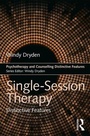
Single-Session Therapy: Distinctive Features provides a general introduction to the field of Single-Session Therapy (SST). Written by eminent clinician and author Windy Dryden, this book challenges mainstream therapeutic assumptions, predicated on the certainty that clients will have more than one therapy session. This book follows the popular Distinctive Features format and is divided into two sections, describing 15 theoretical features and 15 practical techniques of SST.
Single-Session Therapy will be of interest to those across the psychotherapy and counselling professions and will provide extensive guidance for students and practitioners alike.
Single-Session Therapy will be of interest to those across the psychotherapy and counselling professions and will provide extensive guidance for students and practitioners alike.
More details
Series
Language
English
Place of publication
London
United Kingdom
Publishing group
Taylor & Francis Ltd
Target group
College/higher education
Professional and scholarly
Postgraduate, Professional, and Professional Practice & Development
Illustrations
1 s/w Zeichnung, 7 s/w Tabellen
7 Tables, black and white; 1 Line drawings, black and white
Dimensions
Height: 186 mm
Width: 123 mm
Weight
540 gr
ISBN-13
978-0-367-11013-0 (9780367110130)
Copyright in bibliographic data and cover images is held by Nielsen Book Services Limited or by the publishers or by their respective licensors: all rights reserved.
Schweitzer Classification
Other editions
New editions

Book
10/2023
2nd Edition
Routledge
€207.98
Shipment within 10-20 days
Additional editions
Book
02/2019
1st Edition
Routledge
€24.75
Article exhausted; check for reprint
Person
Windy Dryden is in clinical and consultative practice and is an international authority on Cognitive Behaviour Therapy. He is Emeritus Professor of Psychotherapeutic Studies at Goldsmiths, University of London. He has worked in psychotherapy for more than 40 years and is the author of over 225 books.
Content
Preface
Acknowledgements
Part 1: Theory
What's in a name
Misconceptions about SST
People have the capacity to help themselves quickly
SST is based on providing help at the point of need rather than help at the point of availability
The SST mindset
The importance of expectations in SST
SST is a fusion between what the client brings to the process and what the therapist brings to the process
SST challenges therapists' cherished beliefs about therapy and change
What can be achieved from SST
The 'client criteria' question
What makes good SST therapists
For better or for worse: Context matters
The importance of the working alliance
From theory to practice I: Guidelines for good practice
From theory to practice II: What to avoid
Part 2: Practice
Overview: The process of SST
Making a decision about SST
Preparing for the session
Contracting
Getting started
Working with problems and goals
Creating and maintaining a session focus
Doing the work
Utilising client variables
Making an impact
Negotiating the solution
Practising the solution in the session
Bringing the session to a suitable end
Encouraging client reflection, digestion, action and decision
Following-through and following-up
References
Index
Acknowledgements
Part 1: Theory
What's in a name
Misconceptions about SST
People have the capacity to help themselves quickly
SST is based on providing help at the point of need rather than help at the point of availability
The SST mindset
The importance of expectations in SST
SST is a fusion between what the client brings to the process and what the therapist brings to the process
SST challenges therapists' cherished beliefs about therapy and change
What can be achieved from SST
The 'client criteria' question
What makes good SST therapists
For better or for worse: Context matters
The importance of the working alliance
From theory to practice I: Guidelines for good practice
From theory to practice II: What to avoid
Part 2: Practice
Overview: The process of SST
Making a decision about SST
Preparing for the session
Contracting
Getting started
Working with problems and goals
Creating and maintaining a session focus
Doing the work
Utilising client variables
Making an impact
Negotiating the solution
Practising the solution in the session
Bringing the session to a suitable end
Encouraging client reflection, digestion, action and decision
Following-through and following-up
References
Index