

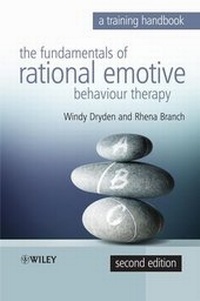
Fundamentals of Rational Emotive Behaviour Therapy
A Training Handbook
2nd Edition
Published on 27. June 2008
Book
Hardback
252 pages
978-0-470-31932-1 (ISBN)
Description
* A complete introduction to REBT, an approach to CBT which argues that at the core of emotional disturbance lies a set of irrational beliefs that people hold about themselves and others
* Essential for counsellors who are beginning to use REBT with clients - recreates the 'feel'of a training course and alerts trainees to difficulties they may experience when using REBT in practice
* Covers all the basic theoretical and practical information that trainees need to begin using REBT, with special attention paid to disputing irrational beliefs and helping clients set goals
* Windy Dryden is the world's best-known and most prolific name in REBT after its founder (the late Albert Ellis), and there is no direct competition to this unique handbook
More details
Edition
2. Auflage
Language
English
Place of publication
New York
United States
Target group
Professional and scholarly
Edition type
New edition
Product notice
Unsewn / adhesive bound
Paper over boards
Dimensions
Height: 249 mm
Width: 173 mm
Thickness: 20 mm
Weight
612 gr
ISBN-13
978-0-470-31932-1 (9780470319321)
Schweitzer Classification
Other editions
Additional editions
E-Book
09/2008
2nd Edition
Wiley
€41.99
Available for download
Book
06/2008
2nd Edition
Wiley
€63.00
Article exhausted; check for reprint
Persons
FrankW. Bond,BA- Honours -, DipPsych, MSc, PhD,CPsychol, is Senior Lecturer in the Department of Psychology at Goldsmiths College, University of London. His research and practice centre around occupational health psychology and, in particular, how work redesign and cognitive behaviour therapies can independently, and together, help to improve workers' psychological health, absenteeism levels, and productivity. Dr Bond also maintains a private practice in cognitive behaviour therapy.
Windy Dryden, BSc, DipPsych, MSc, PhD, CPsychol, is Professor of Counselling at Goldsmiths College, University of London. He is the editor or author of over 125 books in the area of counselling and psychotherapy. His primary interests are rational emotive behaviour therapy and disseminating its theory and techniques to the general public, through writing short, accessible, self-help books.
Windy Dryden, BSc, DipPsych, MSc, PhD, CPsychol, is Professor of Counselling at Goldsmiths College, University of London. He is the editor or author of over 125 books in the area of counselling and psychotherapy. His primary interests are rational emotive behaviour therapy and disseminating its theory and techniques to the general public, through writing short, accessible, self-help books.
Content
About the Authors.
Introduction.
Chapter 1: What you need to know about the theory of rational emotive behaviour therapy to get started.
Chapter 2: What you need to know about the practice of rational emotive behaviour therapy to get started.
Chapter 3: Teaching the "ABC"'s of REBT.
Chapter 4: Distinguishing between healthy and unhealthy negative emotions.
Chapter 5: Being specific in the assessment process.
Chapter 6: Assessing "C".
Chapter 7: Assessing the "critical A".
Chapter 8: Assessing irrational beliefs.
Chapter 9: Assessing meta-emotional problems.
Chapter 10: Goal-setting.
Chapter 11: Eliciting commitment to change.
Chapter 12: Preparing your clients for the disputing process.
Chapter 13: Disputing irrational beliefs: The three major arguments.
Chapter 14: Socratic and didactic disputing of irrational beliefs.
Chapter 15: Examples of Albert Ellis's disputing work.
Chapter 16: Helping your clients to understand the rationality of their rational beliefs.
Chapter 17: Negotiating homework assignments.
Chapter 18: Reviewing homework assignments.
Chapter 19: Dealing with your clients' misconceptions of REBT theory and practice.
Appendix 1: Homework skills monitoring form.
Appendix 2: Possible reasons for not doing homework assignments.
Appendix 3: Training in rational emotive behaviour therapy.
References.
Index.