

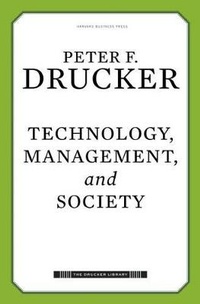
Technology, Management, and Society
Published on 23. November 2010
Book
Hardback
224 pages
978-1-4221-3161-9 (ISBN)
Description
The relationship of humans to technology and management is an ever-growing theme in today's world of ubiquitous mobile devices, constant Internet access, and omnipresent digital business tools. Fifty years ago Peter F. Drucker was already at the forefront of these questions, probing the ways in which management and technology struggle with the shared task of making us more productive. His thinking on how management and technology affect quality of life, what efficiency means versus productivity, and whether management can ever be a true science is as relevant today as it was then.
These twelve essays exhibit, as do all Peter Drucker's writings, crisp reasoning, projection and analysis of short-term realities and examination of long-range goals and possibilities, and a unique voice that makes all these ideas accessible.
These twelve essays exhibit, as do all Peter Drucker's writings, crisp reasoning, projection and analysis of short-term realities and examination of long-range goals and possibilities, and a unique voice that makes all these ideas accessible.
More details
Series
Language
English
Place of publication
Boston
United States
Publishing group
Harvard Business School Publishing
Product notice
Cloth over boards
Dimensions
Height: 235 mm
Width: 156 mm
Weight
425 gr
ISBN-13
978-1-4221-3161-9 (9781422131619)
Copyright in bibliographic data and cover images is held by Nielsen Book Services Limited or by the publishers or by their respective licensors: all rights reserved.
Schweitzer Classification
Other editions
New editions
Peter F. Drucker
Peter F. Drucker on Technology
Book
07/2020
Harvard Business Review Press
€28.50
Shipment within 3-4 weeks
Person
Peter F. Drucker (1909-2005) is one of the best-known and most widely influential thinkers on the subject of management theory and practice, and his writings contributed to the philosophical and practical foundations of the modern corporation.
Often described as "the father of modern management theory," Drucker explored how people are organized across the business, government, and nonprofit sectors of society; he predicted many of the major business developments of the late twentieth century, including privatization and decentralization, the rise of Japan to economic world power, the critical importance of marketing, and the emergence of the information society with its implicit necessity of lifelong learning. In 1959, Drucker coined the term "knowledge worker" and in his later life considered knowledge-worker productivity to be the next frontier of management.
Peter Drucker died on November 11, 2005, in Claremont, California. He had four children and six grandchildren.
You can find more about Peter F. Drucker at cgu.edu/center/the-drucker-institute.
Often described as "the father of modern management theory," Drucker explored how people are organized across the business, government, and nonprofit sectors of society; he predicted many of the major business developments of the late twentieth century, including privatization and decentralization, the rise of Japan to economic world power, the critical importance of marketing, and the emergence of the information society with its implicit necessity of lifelong learning. In 1959, Drucker coined the term "knowledge worker" and in his later life considered knowledge-worker productivity to be the next frontier of management.
Peter Drucker died on November 11, 2005, in Claremont, California. He had four children and six grandchildren.
You can find more about Peter F. Drucker at cgu.edu/center/the-drucker-institute.