

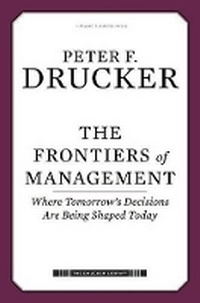
The Frontiers of Management
Where Tomorrow's Decisions Are Being Shaped Today
Published on 15. July 2010
Book
Hardback
384 pages
978-1-4221-3157-2 (ISBN)
Description
Every decision executives make today shapes the future of their organization - as well as that of the communities and society in which the organization operates. How to make choices that lead to the best possible future for all stakeholders? Look beyond the immediate crisis of the day - to the long-term implications of your decisions and actions. In the thirty-five essays comprising The Frontiers of Management, classic management thinker and teacher Peter Drucker offers advice.
Each selection in this compelling collection is as fresh and relevant today as it was when written in the 1980s. With every essay, Drucker teaches by example- deftly demonstrating how to put current events in their larger historical context, how to pick the right people for a given task, how to think through an acquisition.
The book provides not only durable examples of a great thinker's writing but a set of ever more urgently needed lessons on how business leaders today can understand the context of their own daily decisions - and make the wisest possible choices for the future.
Timely and vivid, The Frontiers of Management remains a practical guidebook packed with enduring wisdom.
Each selection in this compelling collection is as fresh and relevant today as it was when written in the 1980s. With every essay, Drucker teaches by example- deftly demonstrating how to put current events in their larger historical context, how to pick the right people for a given task, how to think through an acquisition.
The book provides not only durable examples of a great thinker's writing but a set of ever more urgently needed lessons on how business leaders today can understand the context of their own daily decisions - and make the wisest possible choices for the future.
Timely and vivid, The Frontiers of Management remains a practical guidebook packed with enduring wisdom.
More details
Series
Language
English
Place of publication
Boston
United States
Publishing group
Harvard Business School Publishing
Target group
College/higher education
Product notice
Cloth over boards
Dimensions
Height: 235 mm
Width: 156 mm
Weight
624 gr
ISBN-13
978-1-4221-3157-2 (9781422131572)
Copyright in bibliographic data and cover images is held by Nielsen Book Services Limited or by the publishers or by their respective licensors: all rights reserved.
Schweitzer Classification
Other editions
New editions
Peter F. Drucker
Peter F. Drucker on Globalization
Book
05/2020
Harvard Business Review Press
€28.50
Shipment within 3-4 weeks
Person
Peter F. Drucker (1909-2005) is one of the best-known and most widely influential thinkers on the subject of management theory and practice, and his writings contributed to the philosophical and practical foundations of the modern corporation.
Often described as "the father of modern management theory," Drucker explored how people are organized across the business, government, and nonprofit sectors of society; he predicted many of the major business developments of the late twentieth century, including privatization and decentralization, the rise of Japan to economic world power, the critical importance of marketing, and the emergence of the information society with its implicit necessity of lifelong learning. In 1959, Drucker coined the term "knowledge worker" and in his later life considered knowledge-worker productivity to be the next frontier of management.
Peter Drucker died on November 11, 2005, in Claremont, California. He had four children and six grandchildren.
You can find more about Peter F. Drucker at cgu.edu/center/the-drucker-institute.
Often described as "the father of modern management theory," Drucker explored how people are organized across the business, government, and nonprofit sectors of society; he predicted many of the major business developments of the late twentieth century, including privatization and decentralization, the rise of Japan to economic world power, the critical importance of marketing, and the emergence of the information society with its implicit necessity of lifelong learning. In 1959, Drucker coined the term "knowledge worker" and in his later life considered knowledge-worker productivity to be the next frontier of management.
Peter Drucker died on November 11, 2005, in Claremont, California. He had four children and six grandchildren.
You can find more about Peter F. Drucker at cgu.edu/center/the-drucker-institute.