

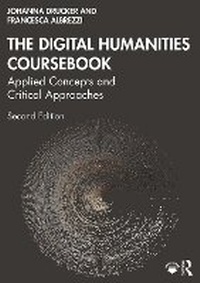
The Digital Humanities Coursebook
Applied Concepts and Critical Approaches
2nd Edition
Published on 10. November 2025
Book
Paperback/Softback
140 pages
978-1-032-96536-9 (ISBN)
Description
This second edition of The Digital Humanities Coursebook provides critical frameworks for the application of digital humanities tools and platforms, which have become an integral part of work across a wide range of disciplines. This fully updated edition adds several new topics, including XR (extended reality) and AI (artificial intelligence), as well as a companion website developed in parallel with the chapters and providing extended ''how-to'' examples to enable students and teachers to follow step-by-step demonstrations of tools or platforms.
Written in an accessible and engaging manner, this book is focused on the principles and fundamental concepts for application and each chapter contains case study examples of projects, tools and platforms that demonstrate these principles in action. This book clearly details how to integrate the acquisition of expertise in data, metadata, classification, interface, visualization, network analysis, topic modeling, data mining, mapping, and web presentation with issues in intellectual property, sustainability, privacy, and the ethical use of information. By combining practical information and critical issues, the book demonstrates that no application of digital humanities can be separated from ethical and critical concerns.
This book is structured to complement courses on digital humanities and provides a series of modules, each of which is organized around a set of concerns and topics, thought experiments and questions, as well as discussions of the ways in which tools and platforms work. Each chapter contains an introduction to the topic, examples of current (and sometimes classic) work being done in the field, a set of exercises to explore the hands-on experience, references, and recommended readings. The Digital Humanities Coursebook will therefore be an indispensable guide for anyone teaching or studying a course in the areas of digital humanities, library and information science, English, or computer science.
Written in an accessible and engaging manner, this book is focused on the principles and fundamental concepts for application and each chapter contains case study examples of projects, tools and platforms that demonstrate these principles in action. This book clearly details how to integrate the acquisition of expertise in data, metadata, classification, interface, visualization, network analysis, topic modeling, data mining, mapping, and web presentation with issues in intellectual property, sustainability, privacy, and the ethical use of information. By combining practical information and critical issues, the book demonstrates that no application of digital humanities can be separated from ethical and critical concerns.
This book is structured to complement courses on digital humanities and provides a series of modules, each of which is organized around a set of concerns and topics, thought experiments and questions, as well as discussions of the ways in which tools and platforms work. Each chapter contains an introduction to the topic, examples of current (and sometimes classic) work being done in the field, a set of exercises to explore the hands-on experience, references, and recommended readings. The Digital Humanities Coursebook will therefore be an indispensable guide for anyone teaching or studying a course in the areas of digital humanities, library and information science, English, or computer science.
More details
Edition
2nd edition
Language
English
Place of publication
London
United Kingdom
Publishing group
Taylor & Francis Ltd
Target group
College/higher education
Professional and scholarly
Academic and Postgraduate
Illustrations
9 s/w Tabellen, 9 s/w Zeichnungen, 24 s/w Abbildungen, 13 s/w Photographien bzw. Rasterbilder
9 Tables, black and white; 9 Line drawings, black and white; 18 Halftones, black and white; 27 Illustrations, black and white
Dimensions
Height: 297 mm
Width: 210 mm
Thickness: 9 mm
Weight
424 gr
ISBN-13
978-1-032-96536-9 (9781032965369)
Copyright in bibliographic data and cover images is held by Nielsen Book Services Limited or by the publishers or by their respective licensors: all rights reserved.
Schweitzer Classification
Other editions
Additional editions
Johanna Drucker | Francesca Albrezzi
The Digital Humanities Coursebook
Applied Concepts and Critical Approaches
E-Book
11/2025
2nd Edition
Routledge
€55.49
Available for download
Johanna Drucker | Francesca Albrezzi
The Digital Humanities Coursebook
Applied Concepts and Critical Approaches
E-Book
11/2025
2nd Edition
Routledge
€55.49
Available for download
Johanna Drucker | Francesca Albrezzi
The Digital Humanities Coursebook
Applied Concepts and Critical Approaches
Book
11/2025
2nd Edition
Routledge
€215.41
Shipment within 10-20 days
Previous edition
Johanna Drucker
The Digital Humanities Coursebook
An Introduction to Digital Methods for Research and Scholarship
Book
03/2021
1st Edition
Routledge
€50.00
Article exhausted; check for reprint
Persons
Johanna Drucker is Breslauer and Distinguished Professor Emerita in the Department of Information Studies, UCLA. She is internationally known for her work in the history of writing, experimental typography, visual poetry, and artists' books as well as information visualization and digital humanities. Her most recent publications include Inventing the Alphabet (2022), Iliazd: Metabiography of a Modernist (2023), and Affluvia: The Toxic Off-Gassing of Affluent Culture (2025).
Francesca Albrezzi, PhD, is a digital research specialist and manager of the GIS and Visualization Research Technology Group at the Office of Advanced Research Computing at UCLA. She is also an Editor-in-Chief and Director of the Virtual Gallery for the International Journal for Digital Art History. Her research focuses on spectrums of immersive experience in GLAM organizations as offered by technologies such as virtual reality, augmented reality, and 360 photo and video capture. She also has significant experience developing digital tools and projects, such as The Getty Scholars' Workspace (TM), for conducting collaborative arts research and preservation.
Francesca Albrezzi, PhD, is a digital research specialist and manager of the GIS and Visualization Research Technology Group at the Office of Advanced Research Computing at UCLA. She is also an Editor-in-Chief and Director of the Virtual Gallery for the International Journal for Digital Art History. Her research focuses on spectrums of immersive experience in GLAM organizations as offered by technologies such as virtual reality, augmented reality, and 360 photo and video capture. She also has significant experience developing digital tools and projects, such as The Getty Scholars' Workspace (TM), for conducting collaborative arts research and preservation.
Content
List of figures and tables; Preface to the Second Edition; 1 Digital humanities overview; 2 Data modeling and use; 3 Digitization; 4 Metadata, markup, and data description; 5 Database design; 6 Multimodal analysis and Data Mining; 7 Information visualization; 8 Mapping and GIS; 9 Immersive and Extended Reality (XR) Technologies; 10 Interface: UI, UX, HCI, and User Testing; 11 Web presentation formats and networked resources; 12 Artificial Intelligence and Machine Learning; 13 Project design and intellectual property; 14 Pedagogy and advanced topics; Index.