

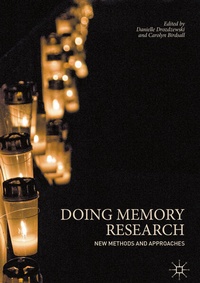
Doing Memory Research
New Methods and Approaches
Published on 25. October 2018
Book
Hardback
XV, 217 pages
978-981-13-1410-0 (ISBN)
Description
Memory studies is a nascent and multidisciplinary research field, drawing from an impressive array of qualitative investigative methods deployed to do memory research. The authors in this collection offer an explicit engagement with the 'doing' of memory research. The contributions demonstrate how attention to methodology reveals rich insights about memory and its links to place and identity.
Reviews / Votes
"No topic is more important for a consolidating field like memory studies than methodology. How was the work that established the field done? What approaches will advance us into its next stage of growth? This important volume, and the essays that comprise it, are exceptionally helpful, and will underwrite the next stage of research in this increasingly important field. An essential contribution!" (Jeffrey K. Olick, Professor of Sociology and History, University of Virginia, USA, and co-president of the Memory Studies Association)More details
Edition
2019 ed.
Language
English
Place of publication
Singapore
Singapore
Target group
Professional and scholarly
Illustrations
19 s/w Abbildungen
XV, 217 p. 19 illus.
Dimensions
Height: 216 mm
Width: 153 mm
Thickness: 18 mm
Weight
423 gr
ISBN-13
978-981-13-1410-0 (9789811314100)
DOI
10.1007/978-981-13-1411-7
Schweitzer Classification
Other editions
Additional editions
Book
02/2019
Springer
€106.99
Shipment within 15-20 days
E-Book
10/2018
1st Edition
Palgrave Macmillan
€96.29
Available for download
Persons
Danielle Drozdzewski is a Senior Lecturer in Human Geography at Stockholm University, Sweden.
Carolyn Birdsall is Assistant Professor of Media Studies at the University of Amsterdam, The Netherlands.
Carolyn Birdsall is Assistant Professor of Media Studies at the University of Amsterdam, The Netherlands.
Content
Chapter 1. Advancing Memory Methods.- Chapter 2. Sensory Impact: Memory, Affect and Sensory Ethnography at Official Memory Sites.- Chapter 3. Using Emplaced Ethnography, Mobility and Listening to Research Memory.- Chapter 4. Biosensing: A Critical Reflection on Doing Memory Research through the Body.- Chapter 5. The Art of Memory after Genocide: Reimagining the Images of the Places of Pain and (Be)longing.- Chapter 6. Beyond Trauma: Researching Memory on My Doorstep.- Chapter 7. Reading-in-Place and Thick Mapping the Venice Ghetto at 500.- Chapter 8. From Place-Memories to Active Citizenship: The Potential of Geotagged User-Generated Content for Memory Scholarship.- Chapter 9. Participatory Methods and Community-Engaged Practices for Collecting, Presenting and Representing Cultural Memory.- Chapter 10. Community Memory Mapping as a Visual Ethnography of Post-War Northeast England.