

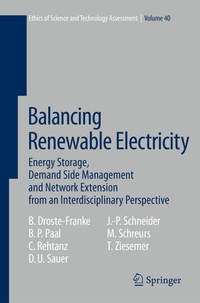
Balancing Renewable Electricity
Energy Storage, Demand Side Management, and Network Extension from an Interdisciplinary Perspective
Published on 23. February 2014
Book
Paperback/Softback
XLVIII, 256 pages
978-3-642-43641-3 (ISBN)
Description
An important aim behind the restructuring of Germany's and Europe's electricity systems is to reduce the environmental burden, especially with respect to greenhouse gas emissions, of the current systems. Emissions must be brought down to a level that is sustainable in the long run and consistent with greenhouse gas emission reduction goals. Meeting these goals will require a system (as best as current knowledge suggests) that will be able to cope simultaneously with the fundamental demands for economic efficiency, environmental sustainability and supply security. Making use of existing scenarios, this study sketches such a system. It focuses in particular on auxiliary systems such as energy storage methods and network extensions.
The study introduces technologies that can balance electricity in energy systems and that can serve as enabling technologies for the integration of large quantities of renewable energies in the power supply system. It begins with a discussion of normativeaims for the future electricity system before continuing with a description of current policies and political developments and an overview of relevant existing energy system studies. These sections serve as background for the remainder of the study. They are followed by discussion and analysis of the growing demand for means to balance the fluctuations found in electricity generated in power systems with a high penetration of renewable energies, the potentials of diverse technologies, requirements for electrical networks, economic impacts and important legal issues. Finally, the main challenges to the achievement of developing balancing technologies and processes for renewable electricity-dominant systems are summarised and recommendations made.
The study introduces technologies that can balance electricity in energy systems and that can serve as enabling technologies for the integration of large quantities of renewable energies in the power supply system. It begins with a discussion of normativeaims for the future electricity system before continuing with a description of current policies and political developments and an overview of relevant existing energy system studies. These sections serve as background for the remainder of the study. They are followed by discussion and analysis of the growing demand for means to balance the fluctuations found in electricity generated in power systems with a high penetration of renewable energies, the potentials of diverse technologies, requirements for electrical networks, economic impacts and important legal issues. Finally, the main challenges to the achievement of developing balancing technologies and processes for renewable electricity-dominant systems are summarised and recommendations made.
More details
Series
Edition
2012 ed.
Language
English
Place of publication
Berlin
Germany
Publishing group
Springer Berlin
Target group
Professional and scholarly
Research
Illustrations
XLVIII, 256 p.
Dimensions
Height: 235 mm
Width: 155 mm
Thickness: 17 mm
Weight
464 gr
ISBN-13
978-3-642-43641-3 (9783642436413)
DOI
10.1007/978-3-642-25157-3
Schweitzer Classification
Other editions
Additional editions
Bert Droste-Franke | Boris P. Paal | Christian Rehtanz
Balancing Renewable Electricity
Energy Storage, Demand Side Management, and Network Extension from an Interdisciplinary Perspective
Book
02/2012
Springer
€106.99
Shipment within 7-9 days
Bert Droste-Franke | Boris P. Paal | Christian Rehtanz
Balancing Renewable Electricity
Energy Storage, Demand Side Management, and Network Extension from an Interdisciplinary Perspective
E-Book
01/2012
1st Edition
Springer
€96.29
Available for download
Persons
Content
Future Perspectives of Electrical Energy Supply.- Existing Energy System Studies.- Demand for Balancing Electrical Energy and Power.- Technologies for Balancing Electrical Energy and Power.- Technology of Electricity Networks, Economical Impacts and Policy.- Legal Analysis of Balancing Strategies.- Analysis of Economic Impacts.- Conclusions and Recommendations.