

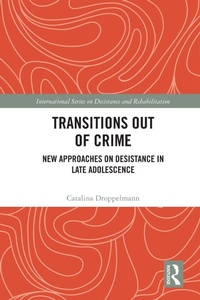
Transitions Out of Crime
New Approaches on Desistance in Late Adolescence
1st Edition
Published on 9. October 2024
Book
Paperback/Softback
198 pages
978-0-367-75031-2 (ISBN)
Description
This book contributes to our knowledge of desistance in a developing country. Offering an intercultural dialogue with mainstream explanations, Transitions Out of Crime analyses the transition from crime to conformity among a group of Chilean juvenile offenders.
Desistance from crime is not just the cessation of criminal activity itself, but a process of acquiring roles, identities, and virtues; of developing new social ties, and of inhabiting new spaces. This book offers new evidence that shows that the traditional binary between the 'reformed desister' and the 'anti-social persister' is inaccurate and that the road to desistance contains various oscillations between crime and conformity. Furthermore, this study shows the role that gender plays in shaping, limiting and structuring pathways away from crime.
Written in a clear and direct style, this book will appeal to those engaged in criminology, sociology, penology, desistance, rehabilitation, gender studies and all those interested in the transition from crime to conformity outside the Anglo-American orthodoxy.
Desistance from crime is not just the cessation of criminal activity itself, but a process of acquiring roles, identities, and virtues; of developing new social ties, and of inhabiting new spaces. This book offers new evidence that shows that the traditional binary between the 'reformed desister' and the 'anti-social persister' is inaccurate and that the road to desistance contains various oscillations between crime and conformity. Furthermore, this study shows the role that gender plays in shaping, limiting and structuring pathways away from crime.
Written in a clear and direct style, this book will appeal to those engaged in criminology, sociology, penology, desistance, rehabilitation, gender studies and all those interested in the transition from crime to conformity outside the Anglo-American orthodoxy.
Reviews / Votes
This invaluable book makes a vital contribution both to decolonising and to gendering desistance research. Through painstaking analysis of the trajectories through crime of young women and men in Chile, Droppelman reveals the ambivalences, inconsistencies and liminality of their transitions to maturity and social integration. Social and psychological factors interact in these transitions and to understand them, we must also situate them in their cultural and structural contexts. This book is a must-read for anyone interested in understanding and supporting desistance - not just in Chile and Latin America, but everywhere.Fergus McNeill, Professor of Criminology and Social Work at the University of Glasgow, Centre for Crime and Justice Research and in Sociology.
The study of desistance from crime, like most areas of criminology, has lacked a strong engagement with the Global South, and this neglect has been to the detriment of theory development. So, Droppelmann's ground-breaking new study of desistance in Chile is a hugely welcomed contribution to the field that will hopefully be a catalyst for new work across Latin America and beyond.
Shadd Maruna, Professor of Criminology, Queen's University Belfast
This book represents major analysis of late adolescence and crime in Latin America. Drawing on precepts of Southern Criminology, and the cultural nuances that this entails, the author delves deeply into the lives of young people to offer insights into both pathways into crime but particularly pathways out of crime, motivations, challenges and transformational processes. This is hugely insightful and invaluable reading for all involved in supporting young people, and in correctional practice and penal reform.
Professor Loraine Gelsthorpe, Director, Institute of Criminology, University of Cambridge
In this fine book, Catalina Droppelmann offers an excellent review of the research literature as well as a pioneering research study of late adolescent offenders in Chile. Her research highlights the uncertainties and difficulties often experienced by would-be desisters from crime, and therefore cautions against drawing neat distinctions between 'desisters' and 'persisters'. Her analysis raises important issues for both researchers and practitioners.
Sir Anthony Bottoms, Emeritus Wolfson Professor of Criminology, University of Cambridge "This invaluable book makes a vital contribution both to decolonising and to gendering desistance research. Through painstaking analysis of the trajectories through crime of young women and men in Chile, Droppelman reveals the ambivalences, inconsistencies and liminality of their transitions to maturity and social integration. Social and psychological factors interact in these transitions and to understand them, we must also situate them in their cultural and structural contexts. This book is a must-read for anyone interested in understanding and supporting desistance - not just in Chile and Latin America, but everywhere."
Fergus McNeill, Professor of Criminology and Social Work at the University of Glasgow, Centre for Crime and Justice Research and in Sociology.
"The study of desistance from crime, like most areas of criminology, has lacked a strong engagement with the Global South, and this neglect has been to the detriment of theory development. So, Droppelmann's ground-breaking new study of desistance in Chile is a hugely welcomed contribution to the field that will hopefully be a catalyst for new work across Latin America and beyond."
Shadd Maruna, Professor of Criminology, Queen's University Belfast
"This book represents major analysis of late adolescence and crime in Latin America. Drawing on precepts of Southern Criminology, and the cultural nuances that this entails, the author delves deeply into the lives of young people to offer insights into both pathways into crime but particularly pathways out of crime, motivations, challenges and transformational processes. This is hugely insightful and invaluable reading for all involved in supporting young people, and in correctional practice and penal reform."
Professor Loraine Gelsthorpe, Director, Institute of Criminology, University of Cambridge
"In this fine book, Catalina Droppelmann offers an excellent review of the research literature as well as a pioneering research study of late adolescent offenders in Chile. Her research highlights the uncertainties and difficulties often experienced by would-be desisters from crime, and therefore cautions against drawing neat distinctions between 'desisters' and 'persisters'. Her analysis raises important issues for both researchers and practitioners."
Sir Anthony Bottoms, Emeritus Wolfson Professor of Criminology, University of Cambridge
More details
Series
Language
English
Place of publication
London
United Kingdom
Publishing group
Taylor & Francis Ltd
Target group
College/higher education
Professional and scholarly
Academic, Postgraduate, and Undergraduate
Illustrations
6 s/w Abbildungen, 6 s/w Zeichnungen, 10 s/w Tabellen
10 Tables, black and white; 6 Line drawings, black and white; 6 Illustrations, black and white
Dimensions
Height: 234 mm
Width: 156 mm
Thickness: 12 mm
Weight
333 gr
ISBN-13
978-0-367-75031-2 (9780367750312)
Copyright in bibliographic data and cover images is held by Nielsen Book Services Limited or by the publishers or by their respective licensors: all rights reserved.
Schweitzer Classification
Other editions
Additional editions
Book
10/2022
1st Edition
Routledge
€185.90
Shipment within 15-20 days
E-Book
12/2021
1st Edition
Routledge
€55.49
Available for download
E-Book
12/2021
1st Edition
Routledge
€55.49
Available for download
Person
Catalina Droppelmann is Lecturer at the Social Science Faculty and leads the Centre for Studies on Justice and Society at the Pontificia Universidad Catolica de Chile. She has worked for more than 20 years researching and teaching on justice, crime, and social exclusion. She holds a BA in Psychology from the University of Valparaiso and an MPhil and a PhD in Criminology at the University of Cambridge. Her interests are on criminal desistance from crime, re- entry policies, and youth justice.
Content
List of figures
List of tables
General Editor's introduction
Acknowledgements
Introduction
1 Desistance and youth crime
2 Researching transitions
3 The process and failed process of moving away from crime
4 Triggers within the liminal space of crime and conformity
5 Housewife, mother, or thief: gendered desistance and persistence
6 Conclusions and implications
Index
List of tables
General Editor's introduction
Acknowledgements
Introduction
1 Desistance and youth crime
2 Researching transitions
3 The process and failed process of moving away from crime
4 Triggers within the liminal space of crime and conformity
5 Housewife, mother, or thief: gendered desistance and persistence
6 Conclusions and implications
Index