

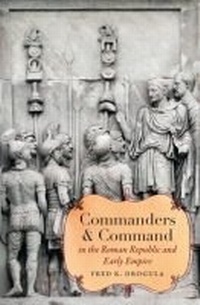
Commanders and Command in the Roman Republic and Early Empire
Published on 30. April 2015
Book
Hardback
432 pages
978-1-4696-2126-5 (ISBN)
Description
In this work, Fred Drogula studies the development of Roman provincial command using the terms and concepts of the Romans themselves as reference points. Beginning in the earliest years of the republic, Drogula argues, provincial command was not a uniform concept fixed in positive law but rather a dynamic set of ideas shaped by traditional practice. Therefore, as the Roman state grew, concepts of authority, control over territory, and military power underwent continual transformation. This adaptability was a tremendous resource for the Romans since it enabled them to respond to new military challenges in effective ways. But it was also a source of conflict over the roles and definitions of power. The rise of popular politics in the late republic enabled men like Pompey and Caesar to use their considerable influence to manipulate the flexible traditions of military command for their own advantage. Later, Augustus used nominal provincial commands to appease the senate even as he concentrated military and governing power under his own control by claiming supreme rule. In doing so, he laid the groundwork for the early empire's rules of command.
More details
Series
Language
English
Place of publication
Chapel Hill
United States
Target group
College/higher education
Dimensions
Height: 235 mm
Width: 156 mm
Thickness: 34 mm
Weight
740 gr
ISBN-13
978-1-4696-2126-5 (9781469621265)
Copyright in bibliographic data and cover images is held by Nielsen Book Services Limited or by the publishers or by their respective licensors: all rights reserved.
Schweitzer Classification
Other editions
Additional editions
Fred K. Drogula
Commanders and Command in the Roman Republic and Early Empire
E-Book
04/2015
The University of North Carolina Press
€19.49
Available for download
Person
Fred K. Drogula is a historian of ancient Greece and Rome. His research focuses on the cultural, political, and intellectual history of the ancient Romans, with a particular interest in the history of the Roman Republic.