

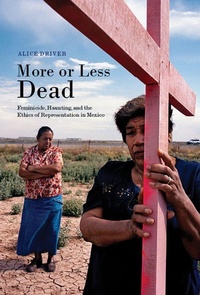
More or Less Dead
Feminicide, Haunting, and the Ethics of Representation in Mexico
2nd Edition
Will be published approx. on 26. March 2015
Book
Hardback
224 pages
978-0-8165-3116-5 (ISBN)
Description
In Ciudad Juarez, Mexico, people disappear, their bodies dumped in deserted city lots or jettisoned in the unforgiving desert. All too many of them are women.
More or Less Dead analyzes how such violence against women has been represented in news media, books, films, photography, and art. Alice Driver argues that the various cultural reports often express anxiety or criticism about how women traverse and inhabit the geography of Ciudad Juarez and further the idea of the public female body as hypersexualized. Rather than searching for justice, the various media-art, photography, and even graffiti-often reuse victimized bodies in sensationalist, attention-grabbing ways. In order to counteract such views, local activists mark the city with graffiti and memorials that create a living memory of the violence and try to humanize the victims of these crimes.
The phrase "more or less dead" was coined by Chilean author Roberto Bolano in his novel 2666, a penetrating fictional study of Juarez. Driver explains that victims are "more or less dead" because their bodies are never found or aren't properly identified, leaving families with an uncertainty lasting for decades-or forever.
The author's clear, precise journalistic style tackles the ethics of representing feminicide victims in Ciudad Juarez. Making a distinction between the words "femicide" (the murder of girls or women) and "feminicide" (murder as a gender-driven event), one of her interviewees says, "Women are killed for being women, and they are victims of masculine violence because they are women. It is a crime of hate against the female gender. These are crimes of power."
More or Less Dead analyzes how such violence against women has been represented in news media, books, films, photography, and art. Alice Driver argues that the various cultural reports often express anxiety or criticism about how women traverse and inhabit the geography of Ciudad Juarez and further the idea of the public female body as hypersexualized. Rather than searching for justice, the various media-art, photography, and even graffiti-often reuse victimized bodies in sensationalist, attention-grabbing ways. In order to counteract such views, local activists mark the city with graffiti and memorials that create a living memory of the violence and try to humanize the victims of these crimes.
The phrase "more or less dead" was coined by Chilean author Roberto Bolano in his novel 2666, a penetrating fictional study of Juarez. Driver explains that victims are "more or less dead" because their bodies are never found or aren't properly identified, leaving families with an uncertainty lasting for decades-or forever.
The author's clear, precise journalistic style tackles the ethics of representing feminicide victims in Ciudad Juarez. Making a distinction between the words "femicide" (the murder of girls or women) and "feminicide" (murder as a gender-driven event), one of her interviewees says, "Women are killed for being women, and they are victims of masculine violence because they are women. It is a crime of hate against the female gender. These are crimes of power."
More details
Edition
2nd edition
Language
English
Place of publication
Tucson
United States
Target group
College/higher education
Product notice
sewn/stitched
Cloth over boards
Illustrations
24 illustrations
Dimensions
Height: 241 mm
Width: 161 mm
Thickness: 28 mm
Weight
443 gr
ISBN-13
978-0-8165-3116-5 (9780816531165)
Copyright in bibliographic data and cover images is held by Nielsen Book Services Limited or by the publishers or by their respective licensors: all rights reserved.
Schweitzer Classification
Person
Alice Driver is a freelance writer, editor, and translator who received her PhD in Hispanic studies from the University of Kentucky, USA in 2011. She recently completed a postdoctoral fellowship at the Universidad Nacional Autonoma de Mexico, where she worked with the Centro de Investigaciones sobre America del Norte to conduct research about the U.S.-Mexico border, immigration, poverty, and violence against women.