

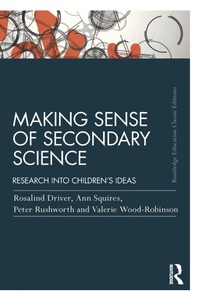
Making Sense of Secondary Science
Research into children's ideas
2nd Edition
Published on 24. September 2014
Book
Paperback/Softback
210 pages
978-1-138-81447-9 (ISBN)
Description
What ideas do children hold about the natural world?
How do these ideas affect their learning of science?
Young learners bring to the classroom knowledge and ideas about many aspects of the natural world constructed from their experiences of education and from outside school. These ideas contribute to subsequent learning, and research has shown that teaching of science is unlikely to be effective unless it takes learners' perspectives into account.
Making Sense of Secondary Science provides a concise, accessible summary of international research into learners' ideas about science, presenting evidence-based insight into the conceptions that learners hold, before and even despite teaching. With expert summaries from across the science domains, it covers research findings from life and living processes, materials and their properties and physical processes
This classic text is essential reading for all trainee secondary, elementary and primary school science teachers, as well as those researching the science curriculum and science methods, who want to deepen their understanding of how learners think and to use these insights to inform teaching strategies. It also provides a baseline for researchers wishing to investigate contemporary influences on children's ideas and to study the persistence of these conceptions.
Both components of Making Sense of Secondary Science - this book and the accompanying teacher's resource file, Making Sense of Secondary Science: Support materials for teachers - were developed as a result of a collaborative project between Leeds City Council Department of Education and the Children's Learning in Science Research Group at the University of Leeds, UK.
How do these ideas affect their learning of science?
Young learners bring to the classroom knowledge and ideas about many aspects of the natural world constructed from their experiences of education and from outside school. These ideas contribute to subsequent learning, and research has shown that teaching of science is unlikely to be effective unless it takes learners' perspectives into account.
Making Sense of Secondary Science provides a concise, accessible summary of international research into learners' ideas about science, presenting evidence-based insight into the conceptions that learners hold, before and even despite teaching. With expert summaries from across the science domains, it covers research findings from life and living processes, materials and their properties and physical processes
This classic text is essential reading for all trainee secondary, elementary and primary school science teachers, as well as those researching the science curriculum and science methods, who want to deepen their understanding of how learners think and to use these insights to inform teaching strategies. It also provides a baseline for researchers wishing to investigate contemporary influences on children's ideas and to study the persistence of these conceptions.
Both components of Making Sense of Secondary Science - this book and the accompanying teacher's resource file, Making Sense of Secondary Science: Support materials for teachers - were developed as a result of a collaborative project between Leeds City Council Department of Education and the Children's Learning in Science Research Group at the University of Leeds, UK.
More details
Series
Edition
2nd edition
Language
English
Place of publication
London
United Kingdom
Publishing group
Taylor & Francis Ltd
Target group
College/higher education
Illustrations
24 s/w Abbildungen, 3 s/w Tabellen
3 Tables, black and white; 24 Illustrations, black and white
Dimensions
Height: 234 mm
Width: 156 mm
Thickness: 12 mm
Weight
354 gr
ISBN-13
978-1-138-81447-9 (9781138814479)
Copyright in bibliographic data and cover images is held by Nielsen Book Services Limited or by the publishers or by their respective licensors: all rights reserved.
Schweitzer Classification
Other editions
Additional editions
Rosalind Driver | Ann Squires | Peter Rushworth
Making Sense of Secondary Science
Research into children's ideas
E-Book
09/2014
2nd Edition
Routledge
€62.99
Available for download
Rosalind Driver | Ann Squires | Peter Rushworth
Making Sense of Secondary Science
Research into children's ideas
E-Book
09/2014
2nd Edition
Routledge
€63.49
Available for download
Rosalind Driver | Ann Squires | Peter Rushworth
Making Sense of Secondary Science
Research into children's ideas
Book
09/2014
2nd Edition
Routledge
€241.70
Shipment within 10-20 days
Previous edition
Rosalind Driver | Ann Squires | Peter Rushworth
Making Sense of Secondary Science
Research into children's ideas
Book
03/1994
Routledge
€54.65
Article exhausted; check for reprint
Persons
The late Rosalind Driver was Professor of Science Education at the University of Leeds where she directed the Children's Learning in Science Project (CLISP), including the project which led to the publication of Making Sense of Secondary Science. ?
Ann Squires, was seconded from the Leeds Education Authority to co-ordinate the Secondary Science Project within CLISP.
Peter Rushworth is a physicist who mentored and trained teachers, and students from various Universities.? He recently retired as a Head teacher.?
Valerie Wood-Robinson has worked on curriculum development projects and has been a local authority education adviser and Ofsted inspector.
Ann Squires, was seconded from the Leeds Education Authority to co-ordinate the Secondary Science Project within CLISP.
Peter Rushworth is a physicist who mentored and trained teachers, and students from various Universities.? He recently retired as a Head teacher.?
Valerie Wood-Robinson has worked on curriculum development projects and has been a local authority education adviser and Ofsted inspector.
Content
Part I: Children's ideas about life and living processes. Living things. Nutrition. Growth. Responding to the environment. Reproduction and inheritance. Microbes. Ecosystems. Part II: Children's ideas about materials and their properties. Materials. Solids, liquids and gases. Chemical change. Particles. Water. Air. Rocks. Part III: Children's ideas about physical processes.