

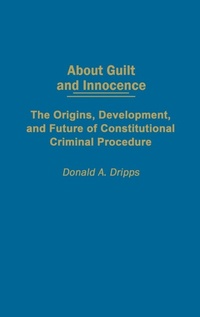
About Guilt and Innocence
The Origins, Development, and Future of Constitutional Criminal Procedure
Published on 30. December 2002
Book
Hardback
320 pages
978-0-275-97730-6 (ISBN)
Description
This remarkably original and vital work argues that the problems are rooted in a disjunction between prevailing values and the prevailing doctrinal regime in constitutional law. Dripps asserts that the Fourteenth Amendment's more general standards of due process and equal protection encompass the values that ought to govern the criminal process.
Why does the American criminal justice system punish too many innocent people, failing to punish so many guilty parties and imposing a disproportionate burden on blacks? This remarkably original and vital work argues that the problems are rooted in a disjunction between prevailing values and the prevailing doctrinal regime in constitutional law. Dripps asserts that the Fourteenth Amendment's more general standards of due process and equal protection encompass the values that ought to govern the criminal process.
Criminal procedure ought to be about protecting the innocent, punishing the guilty, and doing equal justice. Modern legal doctrine, however, hinders these pursuits by concentrating on the specific procedural safeguards contained in the Bill of Rights. Dripps argues that a renewed focus on the Fourteenth Amendment would be more consistent than current law with both our values and with the legitimate sources of Constitutional law, and will promote the instrumental values the criminal process ought to serve. Legal and constitutional scholars will find his account of our criminal system's disarray compelling, and his argument as to how it may be reconstructed important and provoking.
Why does the American criminal justice system punish too many innocent people, failing to punish so many guilty parties and imposing a disproportionate burden on blacks? This remarkably original and vital work argues that the problems are rooted in a disjunction between prevailing values and the prevailing doctrinal regime in constitutional law. Dripps asserts that the Fourteenth Amendment's more general standards of due process and equal protection encompass the values that ought to govern the criminal process.
Criminal procedure ought to be about protecting the innocent, punishing the guilty, and doing equal justice. Modern legal doctrine, however, hinders these pursuits by concentrating on the specific procedural safeguards contained in the Bill of Rights. Dripps argues that a renewed focus on the Fourteenth Amendment would be more consistent than current law with both our values and with the legitimate sources of Constitutional law, and will promote the instrumental values the criminal process ought to serve. Legal and constitutional scholars will find his account of our criminal system's disarray compelling, and his argument as to how it may be reconstructed important and provoking.
More details
Language
English
Place of publication
United States
Publishing group
Bloomsbury Publishing Plc
Target group
College/higher education
Professional and scholarly
Dimensions
Height: 240 mm
Width: 161 mm
Thickness: 22 mm
Weight
643 gr
ISBN-13
978-0-275-97730-6 (9780275977306)
Copyright in bibliographic data and cover images is held by Nielsen Book Services Limited or by the publishers or by their respective licensors: all rights reserved.
Schweitzer Classification
Other editions
Additional editions
Donald A. Dripps
About Guilt and Innocence
The Origins, Development, and Future of Constitutional Criminal Procedure
E-Book
12/2002
1st Edition
Praeger Publishers Inc
€82.49
Available for download
Person
DONALD A. DRIPPS is the James Levee Professor of Law and Criminal Procedure at the University of Minnesota Law School.