

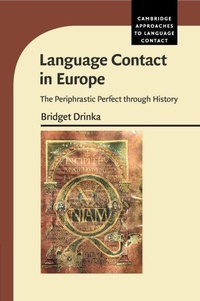
Language Contact in Europe
The Periphrastic Perfect through History
Published on 15. August 2019
Book
Paperback/Softback
506 pages
978-1-108-73191-1 (ISBN)
Description
This comprehensive new work provides extensive evidence for the essential role of language contact as a primary trigger for change. Unique in breadth, it traces the spread of the periphrastic perfect across Europe over the last 2,500 years, illustrating at each stage the micro-responses of speakers and communities to macro-historical pressures. Among the key forces claimed to be responsible for normative innovations in both eastern and western Europe is 'roofing' - the superstratal influence of Greek and Latin on languages under the influence of Greek Orthodoxy and Roman Catholicism respectively. The author provides a new interpretation of the notion of 'sprachbund', presenting the model of a three-dimensional stratified convergence zone, and applies this model to her analysis of the have and be perfects within the Charlemagne sprachbund. The book also tackles broader theoretical issues, for example, demonstrating that the perfect tense should not be viewed as a universal category.
More details
Series
Language
English
Place of publication
Cambridge
United Kingdom
Target group
Professional and scholarly
Product notice
Paperback (trade)
Illustrations
Worked examples or Exercises; 35 Maps; 15 Line drawings, black and white
Dimensions
Height: 229 mm
Width: 152 mm
Thickness: 27 mm
Weight
725 gr
ISBN-13
978-1-108-73191-1 (9781108731911)
Copyright in bibliographic data and cover images is held by Nielsen Book Services Limited or by the publishers or by their respective licensors: all rights reserved.
Schweitzer Classification
Other editions
Additional editions
Book
02/2017
Cambridge University Press
€167.70
Shipment within 15-20 days
Person
Bridget Drinka is a Professor and former Chair of the Department of English at the University of Texas, San Antonio. She has taught at a number of universities worldwide, and has written extensively on Indo-European temporal-aspectual categories, cladistic models of language relationship, stratification as a mapping tool, the 'sacral stamp' of Greek, and on other topics related to her interest in Indo-European, historical, and socio-historical linguistics. She serves as President of the International Society for Historical Linguistics, and as Associate Editor of Folia Linguistica Historica.
Content
1. Language contact in Europe: the periphrastic perfect through history; 2. Languages in contact, areal linguistics and the perfect; 3. The perfect as a category; 4. Sources of the perfect in Indo-European; 5. The periphrastic perfect in Greek; 6. The periphrastic perfect in Latin; 7. The Charlemagne sprachbund and the periphrastic perfects; 8. The core and peripheral features of romance languages; 9. The early development of the perfect in the Germanic languages; 10. The semantic shift of anterior to preterite; 11. The Balkan perfects: grammaticalization and contact; 12. Byzantium, orthodoxy, and old church Slavonic; 13. The l-perfect in North Slavic; 14. Updating the notion of sprachbund: new resultatives and the circum-Baltic 'stratified convergence zone'; 15. The have resultative in Slavic and Baltic; 16. Conclusions.