

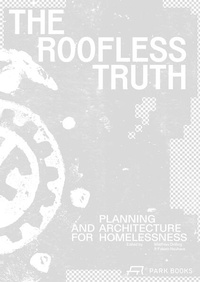
The Roofless Truth
Description
Homelessness is one of the most pressing social challenges of our time, and is closely linked to issues of urban design and architecture. Homeless people are part of urban society and depend on accessible public spaces and urban infrastructure. Yet, in cities around the world, local governments use policies and urban planning to ward off street people, aiming at making them invisible in the cityscape and deliberately impeding certain forms of stay. Urban design always reflects power structures-it can exclude or open up avenues for participation.
The Roofless Truth brings together contributions by international researchers and practitioners from the fields of architecture, urban development and design, sociology, ethnology, social work, and education. It offers academic analyses and essays, field reports, and student proposals for interventions in public space, and features award-winning projects and initiatives in Canada, Germany, Iran, Switzerland, and the US.
The book highlights how public spaces should be designed to offer protection, dignity, and opportunities for homeless people, and to facilitate encounters and interaction. The featured examples impressively demonstrate that even the smallest spatial decision can determine inclusion or exclusion. The Roofless Truth paints a multifaceted picture of planning and design as a social practice beyond representation and prestige.
More details
Persons
Matthias Drilling is a professor at Zurich University of Applied Sciences' School of Social Work, Institute of Diversity and Social Integration. He taught as visiting professor at the University of Calgary's School of Architecture, Planning, and Landscape in 2024-25.
Fabian Neuhaus is an associate professor at the University of Calgary's School of Architecture, Planning, and Landscape, where he directs the NEXTCalgary Research Lab.