

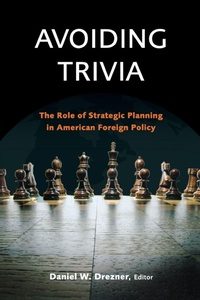
Avoiding Trivia
The Role of Strategic Planning in American Foreign Policy
Published on 5. May 2009
Book
Paperback/Softback
200 pages
978-0-8157-0306-8 (ISBN)
Description
After World War II, George Kennan became the State Department's first director of policy planning. Secretary of State George Marshall's initial advice to Kennan: above all, ""avoid trivia."" Concentrate on the forest, not the trees, and don't lost sight of the big picture. Easier said than done. Avoiding Trivia critically assesses the past, future, and future role and impact of long-term strategic planning in foreign policy.
Strategic planning needs to be a more integral part of America's foreign policymaking. Thousands of troops are engaged in combat while homeland security concerns remain. In such an environment, long-term coordination of goals and resources would seem to be of paramount importance. But history tells us that such cohesiveness and coherence are tremendously difficult to establish, much less maintain. Can policy planners?in the Pentagon, the State Department, Treasury, NSC, and National Intelligence Council?rise to the challenge? Indeed, is strategic planning a viable concept in 21st century foreign policy? These crucial questions guide this eye-opening book.
The contributors include key figures from the past few decades of foreign policy and planning?individuals responsible for imposing some sort of order and strategic priority on foreign policy in a world that changes by the minute. They provide authoritative insight on the difficulties and importance of thinking and acting in a coherent way, for the long term.
Contributors: Andrew P. N. Erdmann, Peter Feaver, Aaron L. Friedberg, David F. Gordon, Richard N. Haass, William Inboden, Bruce W. Jentleson, Steven D. Krasner, Jeffrey W. Legro, Daniel Twining, Thomas Wright, Amy B. Zegart.
Strategic planning needs to be a more integral part of America's foreign policymaking. Thousands of troops are engaged in combat while homeland security concerns remain. In such an environment, long-term coordination of goals and resources would seem to be of paramount importance. But history tells us that such cohesiveness and coherence are tremendously difficult to establish, much less maintain. Can policy planners?in the Pentagon, the State Department, Treasury, NSC, and National Intelligence Council?rise to the challenge? Indeed, is strategic planning a viable concept in 21st century foreign policy? These crucial questions guide this eye-opening book.
The contributors include key figures from the past few decades of foreign policy and planning?individuals responsible for imposing some sort of order and strategic priority on foreign policy in a world that changes by the minute. They provide authoritative insight on the difficulties and importance of thinking and acting in a coherent way, for the long term.
Contributors: Andrew P. N. Erdmann, Peter Feaver, Aaron L. Friedberg, David F. Gordon, Richard N. Haass, William Inboden, Bruce W. Jentleson, Steven D. Krasner, Jeffrey W. Legro, Daniel Twining, Thomas Wright, Amy B. Zegart.
More details
Language
English
Place of publication
United States
Publishing group
Bloomsbury Publishing Plc
Target group
Professional and scholarly
Dimensions
Height: 229 mm
Width: 152 mm
Thickness: 11 mm
Weight
298 gr
ISBN-13
978-0-8157-0306-8 (9780815703068)
Copyright in bibliographic data and cover images is held by Nielsen Book Services Limited or by the publishers or by their respective licensors: all rights reserved.
Schweitzer Classification
Other editions
Additional editions
E-Book
11/2009
1st Edition
Brookings Institution
€26.99
Available for download
E-Book
11/2009
1st Edition
Bloomsbury eBooks US
€26.99
Available for download
Person
Daniel Drezner is a professor of international politics at Tufts University. His previous books inlcude All Politics is Global: Explaining International Regulatory Regimes (Princeton, 2007) and The Sanctions Paradox (Cambridge, 1999). He is also the author of a popular blog on politics and foreign policy (drezner.foreignpolicy.com).