

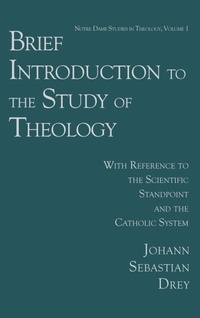
Brief Introduction to the Study of Theology
With Reference to the Scientific Standpoint and the Catholic System
Published on 31. August 1994
Book
Hardback
222 pages
978-0-268-01171-0 (ISBN)
Description
In this landmark text Drey presented an introduction of the study of theology and its methods, which provided not only a program for the way Catholic theology would be studied at Tubingen but also related Catholic theology to the scientific view of German idealist and romantic philosophy.
The Catholic theological faculty at the Tubingen school in Germany in the first half of the nineteenth century are today widely regarded as some of the most significant figures in the development of modern Catholic thought. Up until now, however, little of their work has been available to non-German readers. This English translation makes available for the first time Johann Sebastian Drey's Brief Introduction to the Study of Theology with Reference to the Scientific Standpoint and the Catholic System (1819). In this landmark text Drey presented an encyclopedic introduction to the study of theology and its methods, which provided not only a program for the way Catholic theology would be studied at Tubingen but also related Catholic theology to the scientific views of German idealist and romantic philosophy, especially that of Friedrich Wilhelm Schelling.
In the first part of the book, Drey examines the fundamental concepts of Christian theology-religion, revelation, Christianity, theology-and corrects some erroneous notions about them. In the second and more important part of the book, the "encyclopedia," Drey focuses on how theology as a whole relates to other fields of knowledge and how its various subdisciplines relate to and affect one another. Theology's scholarly growth in the eighteenth century and its branching out into many new fields, such as biblical exegesis, textual criticism, and the new historical methods, brought about the pressing need for such a work.
Anyone concerned with the role of theology and theologians in the Church today will find this book important because Drey was one of the first to insist that the theologian must be responsible to the scholarly and academic world as well as to the Church. In this text he demonstrated that Catholic thought could open itself without fear to modernity and profit from the experience.
The Catholic theological faculty at the Tubingen school in Germany in the first half of the nineteenth century are today widely regarded as some of the most significant figures in the development of modern Catholic thought. Up until now, however, little of their work has been available to non-German readers. This English translation makes available for the first time Johann Sebastian Drey's Brief Introduction to the Study of Theology with Reference to the Scientific Standpoint and the Catholic System (1819). In this landmark text Drey presented an encyclopedic introduction to the study of theology and its methods, which provided not only a program for the way Catholic theology would be studied at Tubingen but also related Catholic theology to the scientific views of German idealist and romantic philosophy, especially that of Friedrich Wilhelm Schelling.
In the first part of the book, Drey examines the fundamental concepts of Christian theology-religion, revelation, Christianity, theology-and corrects some erroneous notions about them. In the second and more important part of the book, the "encyclopedia," Drey focuses on how theology as a whole relates to other fields of knowledge and how its various subdisciplines relate to and affect one another. Theology's scholarly growth in the eighteenth century and its branching out into many new fields, such as biblical exegesis, textual criticism, and the new historical methods, brought about the pressing need for such a work.
Anyone concerned with the role of theology and theologians in the Church today will find this book important because Drey was one of the first to insist that the theologian must be responsible to the scholarly and academic world as well as to the Church. In this text he demonstrated that Catholic thought could open itself without fear to modernity and profit from the experience.
More details
Series
Language
English
Place of publication
Notre Dame IN
United States
Target group
College/higher education
Professional and scholarly
Dimensions
Height: 235 mm
Width: 157 mm
Thickness: 18 mm
Weight
518 gr
ISBN-13
978-0-268-01171-0 (9780268011710)
Copyright in bibliographic data and cover images is held by Nielsen Book Services Limited or by the publishers or by their respective licensors: all rights reserved.
Schweitzer Classification