

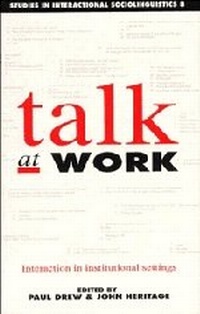
Talk at Work
Interaction in Institutional Settings
Published on 11. February 1993
Book
Hardback
592 pages
978-0-521-37489-7 (ISBN)
Description
In the first collection of its kind, Paul Drew and John Heritage bring together the latest advances in the application of conversation analysis to the study of language and interaction in institutional settings. Leading American and European scholars contribute to Talk at Work original empirical research into the interactions between professionals and 'clients' in a wide variety of settings, including doctor-patient consultations, legal hearings, news interviews, visits by health visitors, psychiatric interviews, and calls to the emergency services. Taken together, their reports are an illuminating exploration of how key aspects of an organisations' work are managed through talk and of the distinctively asymmetric character of institutional discourse. The use of a method at the forefront of research, on recordings of naturally occurring interactions in the settings under scrutiny, uncovers the relationships between social contexts and social actions and offers invaluable insight into the traditional concerns of the sociology and ethnography of organisations, sociolinguistics and pragmatics.
More details
Series
Language
English
Place of publication
Cambridge
United Kingdom
Target group
College/higher education
Professional and scholarly
Dimensions
Height: 224 mm
Width: 145 mm
Thickness: 39 mm
Weight
913 gr
ISBN-13
978-0-521-37489-7 (9780521374897)
Copyright in bibliographic data and cover images is held by Nielsen Book Services Limited or by the publishers or by their respective licensors: all rights reserved.
Schweitzer Classification
Other editions
New editions
Book
02/1993
Cambridge University Press
€123.00
Shipment within 15-20 days
Additional editions
Book
02/1993
Cambridge University Press
€123.00
Shipment within 15-20 days
Persons
Content
Part I. Theoretical orientations: Part II. The activities of questioners: Part III. The activities of answerers: Part IV. The interplay between questioning and answering.