

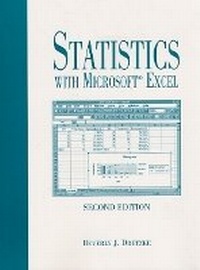
Statistics with Excel
2nd Edition
Published on 19. July 2001
Book
Paperback/Softback
257 pages
978-0-13-022357-9 (ISBN)
Description
For a one or two term course in introductory statistics using Excel. Appropriate for a variety of disciplines including mathematics, the social sciences, and business.
This manual provides statistics students with a complete introduction to statistics using Excel. Its availability, easy-to-understand, basic spreadsheet operations, and analysis tools make Excel a superb software package to carry out statistical analyses in required core courses.
This manual provides statistics students with a complete introduction to statistics using Excel. Its availability, easy-to-understand, basic spreadsheet operations, and analysis tools make Excel a superb software package to carry out statistical analyses in required core courses.
More details
Edition
2nd edition
Language
English
Place of publication
United States
Publishing group
Pearson Education (US)
Target group
Professional and scholarly
Dimensions
Width: 276 mm
Thickness: 15 mm
Weight
580 gr
ISBN-13
978-0-13-022357-9 (9780130223579)
Copyright in bibliographic data and cover images is held by Nielsen Book Services Limited or by the publishers or by their respective licensors: all rights reserved.
Schweitzer Classification
Other editions
New editions

Beverly Dretzke
Statistics with Microsoft Excel
Book
09/2004
3rd Edition
Pearson
€21.03
Article exhausted; check for reprint
Previous edition
Beverly J. Dretzke | Kenneth Heilman
Statistics with Microsoft Excel
Book
02/1998
Pearson
€13.61
Article exhausted; check for reprint
Content
1. Getting Started.
2. Entering, Saving, and Editing Information.
3. Formulas.
4. Frequency Distributions.
5. Descriptive Statistics.
6. Probability Distributions.
7. Testing Hypotheses about One Sample Means.
8. Testing Hypotheses about the Difference between Two Means.
9. Analysis of Variance.
10. Correlation.
11. Regression.
12. Cross Tabulations.
2. Entering, Saving, and Editing Information.
3. Formulas.
4. Frequency Distributions.
5. Descriptive Statistics.
6. Probability Distributions.
7. Testing Hypotheses about One Sample Means.
8. Testing Hypotheses about the Difference between Two Means.
9. Analysis of Variance.
10. Correlation.
11. Regression.
12. Cross Tabulations.