

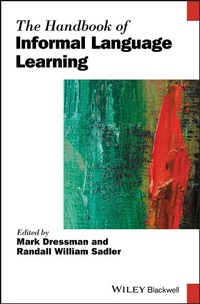
The Handbook of Informal Language Learning
1st Edition
Published on 29. November 2019
Book
Hardback
550 pages
978-1-119-47244-5 (ISBN)
Description
Provides a comprehensive and unique examination of global language learning outside of the formal school setting
Authored by a prominent team of international experts in their respective fields, The Handbook of Informal Language Learning is a one-of-a-kind reference work and it is a timely and valuable resource for anyone looking to explore informal language learning outside of a formal education environment. It features a comprehensive collection of cutting edge research areas exploring the cultural and historical cases of informal language learning, along with the growing area of digital language learning, and the future of this relevant field in national development and language education.
The Handbook of Informal Language Learning examines informal language learning from both theoretical and practical perspectives. Structured across six sections, chapters cover areas of motivation, linguistics, cognition, and multimodality; digital learning, including virtual contexts, gaming, fanfiction, vlogging, mobile devices, and nonformal programs; and media and live contact, including learning through environmental print, tourism/study abroad. The book also provides studies of informal learning in four national contexts, examines the integration of informal and formal classroom learning, and discusses the future of language learning from different perspectives.
* Edited by respected researchers of computer-mediated communication and second language learning and teacher education
* Features contributions by leading international scholars reaching out to a global audience
* Presents an exciting and progressive selection of chapters in a rapidly expanding field of research and teaching
* Provides a state-of-the-art collection of the theories, as well as the historical, cultural and international cases relating to informal language learning and its future in a digital age
* Covers 30 key topics that represent pioneering findings and new research
The Handbook of Informal Language Learning is an essential resource for researchers, students, and professionals in the fields of language acquisition, English as a second language, and foreign language education.
Reviews / Votes
"I am familiar with Sadler's work having attended some of his conference presentations and served with him on the CALICO Executive Board. I know that he is well connected within the field of technology and language learning, which should help in recruiting authors... This is the kind of book that is well-suited to libraries, and I would think that individual chapters would find their ways into course readers in more general technology and language learning teacher preparation courses."Phil Hubbard, Stanford University, USA
"My overall impression is that the proposed volume provides a highly important contribution to the endeavor of language learning. The premise is intriguing, in that it is focused on an area of research in language learning which is often left aside in research and on language teacher training programs, that of informal language learning. It is an exciting and novel approach to theorizing about language learning - one which will serve to inform studies of formal language learning and research into second language acquisition."
Anne McCabe, Saint Louis University, USA
"I think a handbook on informal language learning is timely and much needed. I like how the authors proposed to start with a clear theorization of informal language learning from different perspectives and how it covers a wide range of aspects related to informal language learning."
Chun Lai, University of Hong Kong, Hong Kong
More details
Other editions
Additional editions
Mark Dressman | Randall William Sadler
The Handbook of Informal Language Learning
Book
12/2024
1st Edition
Wiley-Blackwell
€50.70
Shipment within 15-20 days
Mark Dressman | Randall William Sadler
The Handbook of Informal Language Learning
E-Book
12/2019
1st Edition
Wiley-ISTE
€179.99
Available for download
Mark Dressman | Randall William Sadler
The Handbook of Informal Language Learning
E-Book
12/2019
1st Edition
Wiley-ISTE
€179.99
Available for download
Persons
Mark Dressman is Professor and Chair of English at Khalifa University in Abu Dhabi, UAE, and Professor Emeritus in the Department of Curriculum and Instruction at the University of Illinois at Urbana-Champaign, USA. He has authored four books, including Using social theory in educational research: A practical guide (2008), and more than thirty journal articles on curriculum and the teaching of English as a first and other language.
Randall Sadler is Associate Professor of Linguistics and Director of TESL and ESL at the University of Illinois, USA. He teaches courses on telecollaboration, virtual worlds, and teaching L2 reading and writing and focuses his research on technology in language learning. He is author of Virtual Worlds for Language Learning: From Theory to Practice (2012) and has published in many journals, including Journal of English for Academic Purposes, CALICO, ReCALL, Language Learning & Technology.
Content
Notes on Contributors
Introduction:
Mark Dressman and Randall Sadler
Part 1: Theorizing Informal Language Learning
1. Motivation and Informal Language Learning
Alice Chick
2. Learning Languages in Informal Environments: Some Cognitive Considerations
Kiel Christianson and Sarah-Elizabeth Deshaies.
3. Multimodality and Language Learning
Mark Dressman
4. Linguistics: How Learning Context Shapes Heritage and Second-Language Acquisition
Silvina Montryl
5. Literacy: Informal Writing and Language Learning
Paul Matsuda and Melika Nouri
Part 2: Learning in Digital Contexts
6. Virtual Landscapes
Randler Sadler
7. Gaming and Informal Language Learning
Stephanie W.P. Knight, Lindsay Marean and Julie M.Sykes
8. Self-Paced Language Learning Using Online Platforms
Panagiotis Aravanitis
9. FanFiction and Informal Language Learning
Shannon Sauro
10. Vlogs, Video Publishing, and Informal Language Learning
Tatiana Codreanu
11. Mobile collaboration for language learning and cultural learning
Agnes Kukulska and Helen Lee
Part 3: Learning through Media and Live Contact
12. Video and Informal Language Learning
Robert Vanderplank
13. Songs and Music
Karen M Ludke
14. Mobility, Media, and Multiplicity: Immigrants' Informal Language Learning Media
Kristen H. Perry, Annie M. Moses and John Carrol
15. Service Sector Work and Informal Language Learning
Hania Janta and Stefan Keller
16. Linguistic Landscapes and Additional Language Development
Jana Roos and Howard Nicholas
17. Language Tourism and Second Language Acquisition in Informal Learning Contexts
Montserrat Iglesisas
Part 4: International Case Studies of Informal Language Learners
18. Hong Kong and Informal Language Learning
Chun Lai and Bo Ning Lyu
19. An Emerging Path to English in Korea: Informal Digital Learning
Ju Seong Lee
20. Informal Language Learning among Moroccan Youth
Mark Dressman
21. Sweden and Informal Language Learning
Pia Sundqvist
22. Informal English Learning in France
Meryl Kusyk
Part 5: Informal Learning and Formal Contexts
23. Translanguaging across Contexts
Sarah Mccarthey, Idalia Nunez and Chaehyun Lee
24. A Critical Review of Social Networks for Language Learning beyond the Classroom
Katerina Zourou
25. Digital Writing in Informal Settings among Multilanguage Learners
Binbin Zheng and Chin-Hsi Lin
26. Extensive Reading for Statistical Learning
Doreen E. Ewert
27. Leveraging Technology to Integrate Informal Language Learning Within Classroom Settings
Philip Hubbard
28. Connecting Informal and Informal Language Learning
Dennis Murphy Odo
Part 6: The Present and Future of Informal Language Learning
29. Digital Translation: Its Potential and Limitations for Informal Language Learning
Helen Slatyer and Sarah Forget
30. Future Directions in Informal Language Learning
Robert Godwin-Jones
31. Last Words: Naming, Framing, and Challenging the Field
Geoffrey Sockett