

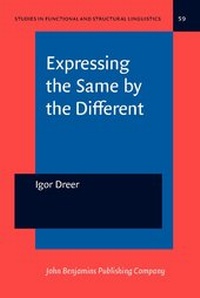
Expressing the Same by the Different
The subjunctive vs the indicative in French
Published on 15. September 2007
Book
Hardback
272 pages
978-90-272-1568-0 (ISBN)
Description
This volume offers an alternative, sign-oriented analysis of the distribution of the French Indicative and Subjunctive. It rejects both government and functions, attributed to both moods, and shows that the distribution of the Indicative and the Subjunctive is motivated by their invariant meanings. The volume illustrates the close interaction between the Indicative and the Subjunctive, as linguistic signs, and signs of other grammatical systems, contextually associated with the invariant meanings of both moods. Special consideration is given to the use of the Indicative and the Subjunctive in texts of different styles and genres.This volume also deals with the diachronic disfavoring of the Subjunctive and especially of the Imperfect Subjunctive that occurred from Old French to Contemporary French. It is argued that this disfavoring was motivated by the narrowing of the invariant meaning of the Contemporary French Subjunctive. All hypotheses are supported by contextualized examples and frequency counts.
More details
Series
Language
English
Place of publication
Amsterdam
Netherlands
Target group
Professional and scholarly
Dimensions
Height: 245 mm
Width: 164 mm
Weight
690 gr
ISBN-13
978-90-272-1568-0 (9789027215680)
Copyright in bibliographic data and cover images is held by Nielsen Book Services Limited or by the publishers or by their respective licensors: all rights reserved.
Schweitzer Classification
Other editions
Additional editions
E-Book
09/2007
1st Edition
John Benjamins Publishing Company
€136.99
Available for download
Person
Content
1. Dedication; 2. Acknowledgements; 3. List of tables; 4. List of figures; 5. Preface; 6. Part 1. The problem of French mood; 7. 1. Sentence-oriented approaches; 8. 2. Sign-oriented approaches; 9. Part 2. Columbia School theory; 10. 3. The basic principles; 11. 4. Hypothesis; 12. Part 3. "Micro-level" analysis; 13. 5. Occurrence System and the encoder's commitment; 14. 6. Occurrence System and subjective comment; 15. 7. Occurrence System and negation; 16. Part 4. "Macro-level" analysis; 17. 8. "From sign to text" approach; 18. 9. "From text to sign" approach; 19. Part 5. The subjunctive moods: Diachronic analysis; 20. 10. Previous explanations for the use of the Subjunctive forms and for their disfavoring; 21. 11. The analysis of the general disfavoring of the Subjunctive; 22. 12. The analysis of the disfavoring of the Imperfect Subjunctive; 23. 13. The Subjunctive moods in Old French: "Micro-level" analysis; 24. 14. The Subjunctive moods in Old French: "Macro-level" analysis; 25. 15. The Subjunctive moods in contemporary French: "Micro-level" analysis; 26. 16. The Subjunctive moods in contemporary French: "Macro-level" analysis; 27. Concluding remarks; 28. List of references; 29. Name index; 30. Subject index