

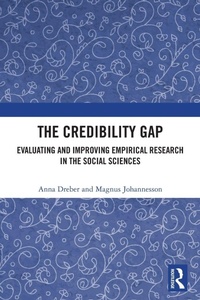
The Credibility Gap
Evaluating and Improving Empirical Research in the Social Sciences
1st Edition
Will be published approx. on 20. July 2026
Book
Paperback/Softback
151 pages
978-1-032-94294-0 (ISBN)
Description
Which scientific results can we trust? This question has been brought to the forefront of research in the social sciences in recent years with the movement towards open science practices and preregistration. Systematic replication studies of laboratory experiments in the social sciences have found that only about half of the "statistically significant" results published in top journals can be replicated in the sense that similar results are achieved with new data. This low replicability may be even lower in studies based on observational data as such studies have more degrees of freedom in the analysis of the data leading to larger possibilities to selectively report more publishable findings.
In this book, the authors provide a framework for evaluating reproducibility, replicability and generalizability of empirical research in the social sciences. They define different types of reproducibility and replicability and show how they can be measured to evaluate the credibility of published findings. Different approaches to improving the credibility of published findings, such as preregistration with detailed pre-analysis plans, Registered Report publications, and preregistered prospective meta-analysis are also outlined and discussed. Even if published results are not systematically biased, the variation in results across populations, research designs, and analyses decreases the reliability and generalizability of published findings. The book shows how such heterogeneity in results can be measured and incorporated in the analysis to more accurately represent the uncertainty and thereby generalizability of reported results.
In this book, the authors provide a framework for evaluating reproducibility, replicability and generalizability of empirical research in the social sciences. They define different types of reproducibility and replicability and show how they can be measured to evaluate the credibility of published findings. Different approaches to improving the credibility of published findings, such as preregistration with detailed pre-analysis plans, Registered Report publications, and preregistered prospective meta-analysis are also outlined and discussed. Even if published results are not systematically biased, the variation in results across populations, research designs, and analyses decreases the reliability and generalizability of published findings. The book shows how such heterogeneity in results can be measured and incorporated in the analysis to more accurately represent the uncertainty and thereby generalizability of reported results.
Reviews / Votes
"The integrity of social science research has been challenged. This book offers a comprehensive, detective-style view of what went wrong. It also outlines ways to fix the problems and restore trust. A must-read for anyone interested in empirical work in social science!"Uri Gneezy, Rady School of Management, UC San Diego
"I can think of no one better situated than these authors to lay the groundwork for improving the social sciences. This book is a must-read for anyone curious about the integrity of social science research and eager to explore new frontiers to build the stock of knowledge to change the world."
John List, Department of Economics, University of Chicago
More details
Language
English
Place of publication
London
United Kingdom
Publishing group
Taylor & Francis Ltd
Target group
College/higher education
Postgraduate
Illustrations
13 s/w Tabellen, 15 farbige Zeichnungen, 15 farbige Abbildungen
13 Tables, black and white; 15 Line drawings, color; 15 Illustrations, color
Dimensions
Height: 234 mm
Width: 156 mm
ISBN-13
978-1-032-94294-0 (9781032942940)
Copyright in bibliographic data and cover images is held by Nielsen Book Services Limited or by the publishers or by their respective licensors: all rights reserved.
Schweitzer Classification
Other editions
Additional editions
Anna Dreber | Magnus Johannesson
The Credibility Gap
Evaluating and Improving Empirical Research in the Social Sciences
E-Book
04/2025
1st Edition
Routledge
€60.49
Available for download
Anna Dreber | Magnus Johannesson
The Credibility Gap
Evaluating and Improving Empirical Research in the Social Sciences
Book
04/2025
1st Edition
Routledge
€219.40
Shipment within 10-20 days
Anna Dreber | Magnus Johannesson
The Credibility Gap
Evaluating and Improving Empirical Research in the Social Sciences
E-Book
04/2025
1st Edition
Routledge
€60.49
Available for download
Persons
Anna Dreber is Professor of economics at the Stockholm School of Economics, Sweden.
Magnus Johannesson is Professor of economics at the Stockholm School of Economics, Sweden.
Magnus Johannesson is Professor of economics at the Stockholm School of Economics, Sweden.
Content
1. Introduction 2. p-values, power and p-hacking 3. Pre-registration 4. A framework for evaluating reproducibility and replicability 5. Results from large-scale reproducibility studies 6. Results from large-scale replicability studies 7. Predicting replications 8. A framework for evaluating heterogeneity and generalizability 9. Empirical estimates of heterogeneity 10. Meta-analysis and aggregating research findings 11. Debugging observational data studies 12. Conclusion