

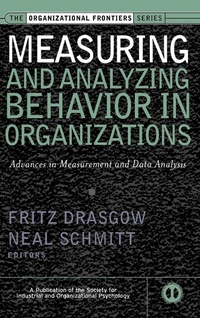
Measuring and Analyzing Behavior in Organizations
Advances in Measurement and Data Analysis
1st Edition
Published on 23. November 2001
Book
Hardback
624 pages
978-0-7879-5301-0 (ISBN)
Description
Measuring and Analyzing Behavior in Organizations brings together the latest advances in measurement and data analysis, providing accessible, current discussions of measurement, applied statistics, research methods, and data analysis. The book details the range of problems that can be addressed with these new approaches, answering the more complex questions with sophisticated analyses that can extract more information from the data than simpler methods. The contributors provide workable solutions to many previously intractable problems, including those that require measuring change, studying person-environment fit, understanding the effects of error, and more.
Reviews / Votes
"This is an excellent book that most of us will find useful."(Personnel Psychology, Spring 2003)More details
Series
Language
English
Place of publication
United States
Publishing group
John Wiley & Sons Inc
Target group
College/higher education
Professional and scholarly
Product notice
sewn/stitched
Cloth over boards
With dust jacket
Illustrations
Tables: 45 B&W, 0 Color; Graphs: 45 B&W, 0 Color
Dimensions
Height: 235 mm
Width: 157 mm
Thickness: 41 mm
Weight
1146 gr
ISBN-13
978-0-7879-5301-0 (9780787953010)
Copyright in bibliographic data and cover images is held by Nielsen Book Services Limited or by the publishers or by their respective licensors: all rights reserved.
Schweitzer Classification
Persons
Fritz Drasgow is a professor of psychology and director of theCenter for Human Resources Management at the University ofIllinois. He is also the current chair of Scientific Affairs at theSociety for Industrial and Organizational Psychology.
Neal Schmitt is University Distinguished Professor of Psychologyand Management and chair of the psychology department at MichiganState University. He is the editor of SIOP's OrganizationalFrontiers series.
Neal Schmitt is University Distinguished Professor of Psychologyand Management and chair of the psychology department at MichiganState University. He is the editor of SIOP's OrganizationalFrontiers series.
Content
Foreword (Neal Schmitt).
Preface.
The Contributors.
Part One: Introduction.
1. Applied Problems and Methods of Analysis: A Road Map (NealSchmitt, Fritz Drasgow).
Part Two: Description and Measurement of Variables.
2. The Grounded Theory Approach to Qualitative Research (KarenLocke).
3. Computer-Based Advances in Assessment (Julie B.Olson-Buchanan).
4. Item Response Theory for Dichotomous Assessment Data (StevenPaul Reise, Niels G. Waller).
5. Modeling Data with Polytomous Item Response Theory (Michael J.Zickar).
6. Differential Item and Test Functioning (Nambury S. Raju, BarbaraB. Ellis).
7. Generalizability Theory (Richard P. DeShon).
8. Confirmatory Factor Analysis (Charles E. Lance, Robert J.Vandenberg).
Part Three: Examining the Interrelationships Among Variables andTesting Substantive Hypotheses.
9. Structural Equation Modeling: A User's Guide (Roger E.Millsap).
10. Latent Growth Modeling (David Chan).
11. Alternatives to Difference Scores: Polynomial RegressionAnalysis and Response Surface Methodology (Jeffrey R.Edwards).
12. Multilevel Random Coefficient Modeling in OrganizationalResearch: Examples Using SAS and S-PLUS (Paul D. Bliese).
13. Structure and Timing in Limited Range Dependent Variables:Regression Models for Predicting If and When (David A.Harrison).
14. Computational Modeling in Organizational
Sciences: Contributions of a Third Research Discipline (CharlesHulin, Andrew G. Miner, Steven T. Seitz).
15. Meta-Analysis: A Review of Quantitative Cumulation Methods(Hannah R. Rothstein, Michael A. McDaniel, MichaelBorenstein).
Name Index.
Subject Index.
Preface.
The Contributors.
Part One: Introduction.
1. Applied Problems and Methods of Analysis: A Road Map (NealSchmitt, Fritz Drasgow).
Part Two: Description and Measurement of Variables.
2. The Grounded Theory Approach to Qualitative Research (KarenLocke).
3. Computer-Based Advances in Assessment (Julie B.Olson-Buchanan).
4. Item Response Theory for Dichotomous Assessment Data (StevenPaul Reise, Niels G. Waller).
5. Modeling Data with Polytomous Item Response Theory (Michael J.Zickar).
6. Differential Item and Test Functioning (Nambury S. Raju, BarbaraB. Ellis).
7. Generalizability Theory (Richard P. DeShon).
8. Confirmatory Factor Analysis (Charles E. Lance, Robert J.Vandenberg).
Part Three: Examining the Interrelationships Among Variables andTesting Substantive Hypotheses.
9. Structural Equation Modeling: A User's Guide (Roger E.Millsap).
10. Latent Growth Modeling (David Chan).
11. Alternatives to Difference Scores: Polynomial RegressionAnalysis and Response Surface Methodology (Jeffrey R.Edwards).
12. Multilevel Random Coefficient Modeling in OrganizationalResearch: Examples Using SAS and S-PLUS (Paul D. Bliese).
13. Structure and Timing in Limited Range Dependent Variables:Regression Models for Predicting If and When (David A.Harrison).
14. Computational Modeling in Organizational
Sciences: Contributions of a Third Research Discipline (CharlesHulin, Andrew G. Miner, Steven T. Seitz).
15. Meta-Analysis: A Review of Quantitative Cumulation Methods(Hannah R. Rothstein, Michael A. McDaniel, MichaelBorenstein).
Name Index.
Subject Index.