

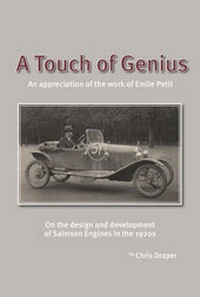
A touch of Genius
An appreciation of the work of Emile Petit - On the design and development of Salmson Engines in the 1920s
Published on 11. July 2016
Book
Paperback/Softback
154 pages
978-3-940732-28-6 (ISBN)
Description
Author's introduction
I am lucky enough to have owned one of Petit's creations for around fifty years. I was
also fortunate to have met him, at his home in Paris, on at least three visits. He was a
charming man and still proud of his Peugeot fitted with a Petit supercharger - one of
his last contributions to automotive design. Unfortunately I failed to ask him many
questions during these interviews - an opportunity missed.
These notes - although consistent with what he explained to me, do contain a large
element of assumption which is based on my long exposure to his work.
It must also be recalled that Petit designed the first AL Salmson in six months working
half days. He ordered all the parts, supervised the assembly - met the 350kgs weight
target with 348kgs, the car then won the Six Days Swiss Trial with virtually no testing.
One of the things about Petit's Salmson designs, that has always impressed me, is that
they worked "straight out of the Box" nearly no modifications being required during
the period they were in production.
An excellent example of his Genius!
The basic design was also good enough to dominate cyclecar races in the first half of
the 1920s and good enough to be competitive - after the addition of a supercharger
in the second haft of the vintage period and continued to put up excellent performances
into the immediate post war period.
I have tried to demonstrate how the same basic design was suitable for a comparatively
heavy touring car, and with relative minor redesign was capable of being an outstanding
racing engine.
I have included a comparison with the 1920 Ballot twin camshaft engine, which was
considerably more complex to build, and maintain and produced very similar specific
power outputs.
In recent years far too few of these engines have been used in competition - I attribute
this to the very highly modified Austin and Riley engines being used today that bear no
relationship to their forefathers that were raced in the 1920s to 1930s and which in
generally took a poor second place to Petit's work when they were contemporary
However, they can no longer be accepted as the yard stick by which Salmsons are
measured and often found wanting. It is best to appreciate Petit's work and enjoy the
cars and engines as he built them.
Chris Draper
February 2015
I am lucky enough to have owned one of Petit's creations for around fifty years. I was
also fortunate to have met him, at his home in Paris, on at least three visits. He was a
charming man and still proud of his Peugeot fitted with a Petit supercharger - one of
his last contributions to automotive design. Unfortunately I failed to ask him many
questions during these interviews - an opportunity missed.
These notes - although consistent with what he explained to me, do contain a large
element of assumption which is based on my long exposure to his work.
It must also be recalled that Petit designed the first AL Salmson in six months working
half days. He ordered all the parts, supervised the assembly - met the 350kgs weight
target with 348kgs, the car then won the Six Days Swiss Trial with virtually no testing.
One of the things about Petit's Salmson designs, that has always impressed me, is that
they worked "straight out of the Box" nearly no modifications being required during
the period they were in production.
An excellent example of his Genius!
The basic design was also good enough to dominate cyclecar races in the first half of
the 1920s and good enough to be competitive - after the addition of a supercharger
in the second haft of the vintage period and continued to put up excellent performances
into the immediate post war period.
I have tried to demonstrate how the same basic design was suitable for a comparatively
heavy touring car, and with relative minor redesign was capable of being an outstanding
racing engine.
I have included a comparison with the 1920 Ballot twin camshaft engine, which was
considerably more complex to build, and maintain and produced very similar specific
power outputs.
In recent years far too few of these engines have been used in competition - I attribute
this to the very highly modified Austin and Riley engines being used today that bear no
relationship to their forefathers that were raced in the 1920s to 1930s and which in
generally took a poor second place to Petit's work when they were contemporary
However, they can no longer be accepted as the yard stick by which Salmsons are
measured and often found wanting. It is best to appreciate Petit's work and enjoy the
cars and engines as he built them.
Chris Draper
February 2015