

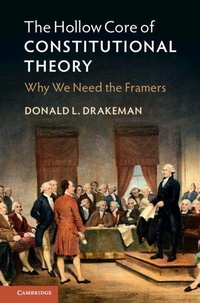
The Hollow Core of Constitutional Theory
Why We Need the Framers
Published on 8. April 2021
Book
Paperback/Softback
248 pages
978-1-108-71939-1 (ISBN)
Description
The Hollow Core of Constitutional Theory is the first major defense of the central role of the Framers' intentions in constitutional interpretation to appear in years. This book starts with a reminder that, for virtually all of Western legal history, when judges interpreted legal texts, their goal was to identify the lawmaker's will. However, for the past fifty years, constitutional theory has increasingly shifted its focus away from the Framers. Contemporary constitutional theorists, who often disagree with each other about virtually everything else, have come to share the view that the Framers' understandings are unknowable and irrelevant. This book shows why constitutional interpretation needs to return to its historical core inquiry, which is a search for the Framers' intentions. Doing so is practically feasible, theoretically defensible, and equally important not only for discovering the original meaning, but also for deciding how to apply the Constitution today.
Reviews / Votes
'Drakeman's treatment and criticisms of constitutional theory - whether of originalism or non-originalism - are unfailingly fair and insightful. His arguments for incorporating the framers' intent into constitutional interpretation today are historically rich and conceptually cogent. A penetrating book sure to be of great interest to the specialist and general reader alike.' Marc O. DeGirolami, Cary Fields Professor of Law, St. John's University School of Law 'Drakeman writes with clarity, wit, and power ...' Stephen B. Presser, The Federalist Society Review 'Drakeman finds his way ... to the central truth of the matter.' Hadley Arkes, Claremont Review of Books 'A powerful brief written to academics on behalf of the public who want to know the Constitution's meaning.' Adam J. Macleod, Law & Liberty 'Cuts against the grain of both liberal and modern originalist jurisprudence.' Stone Washington, City Journal 'The book is compelling. Greg Weiner' The Constitutionalist 'Drakeman speaks the unpleasant truth that rarely speaks its name: in-stead of taking their lead from the Constitution, many judges simply begin with their own sense of what the right outcome should be.' Hadley Arkes, Claremont Review of Books 'Despite the complexity of the topic and his historical explorations, Drakeman keeps his writing appropriate to most readers, especially those with some legal training. It is far more readable than many similar works. I recommend this book for all academic law libraries.' Firiel Hubbell, Law Library JournalMore details
Language
English
Place of publication
Cambridge
United Kingdom
Target group
Professional and scholarly
Product notice
Paperback (trade)
Illustrations
Worked examples or Exercises
Dimensions
Height: 229 mm
Width: 152 mm
Thickness: 14 mm
Weight
365 gr
ISBN-13
978-1-108-71939-1 (9781108719391)
Copyright in bibliographic data and cover images is held by Nielsen Book Services Limited or by the publishers or by their respective licensors: all rights reserved.
Schweitzer Classification
Other editions
Additional editions
Book
04/2021
Cambridge University Press
€128.80
Shipment within 15-20 days
Person
Donald L. Drakeman is Distinguished Research Professor in the Program on Constitutional Studies at the University of Notre Dame, and a Fellow of the Centre for Health Leadership and Enterprise at the University of Cambridge. His works have been cited by the Supreme Courts of the United States and the Philippines. His books on the Constitution include Church, State, and Original Intent (Cambridge, 2009), a Choice Outstanding Academic Title.
Content
1. The Framers and Contemporary Constitutional Theory; 2. The Framers' Intentions: Who, What, and Where; 3. Original Methods and the Limits of Interpretation; 4. Original Methods Updating; 5. The Semantic Summing Problem; 6. Is Corpus Linguistics Better than Flipping a Coin?; 7. The Framers' Intentions Can Solve the Semantic Summing Problem; 8. Interpretation and Sociological Legitimacy; 9. Noninterpretive Decisions; 10. Conclusion.