

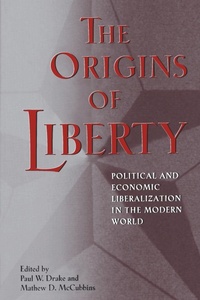
The Origins of Liberty
Political and Economic Liberalization in the Modern World
Published on 12. April 1998
Book
Paperback/Softback
224 pages
978-0-691-05755-2 (ISBN)
Description
Why would sovereigns ever grant political or economic liberty to their subjects? Under what conditions would rational rulers who possess ultimate authority and who seek to maximize power and wealth ever give up any of that authority? This book draws on a wide array of empirical and theoretical approaches to answer these questions, investigating both why sovereign powers might liberalize and when. The contributors to this volume argue that liberalization or democratization will only occur when those in power calculate that the expected benefits to them will exceed the costs. More specifically, rulers take five main concerns into account in their cost-benefit analysis as they decide to reinforce or relax controls: personal welfare, personal power, internal order, external order, and control over policy--particularly economic policy. The book shows that repression is a tempting first option for rulers seeking to maximize their benefits, but that liberalization becomes more attractive as a means of minimizing losses when it becomes increasingly certain that the alternatives are chaos, deposition, or even death.
Chapters cover topics as diverse as the politics of seventeenth-century England and of twentieth-century Chile; why so many countries have liberalized in recent decades; and why even democratic governments see a need to reduce state power. The book makes use of formal modeling, statistical analysis, and traditional historical analysis. The contributors are Paul Drake, Stephen Haggard, William Heller, Robert Kaufman, Phil Keefer, Brian Loveman, Mathew McCubbins, Douglass North, Ronald Rogowski, and Barry Weingast.
Chapters cover topics as diverse as the politics of seventeenth-century England and of twentieth-century Chile; why so many countries have liberalized in recent decades; and why even democratic governments see a need to reduce state power. The book makes use of formal modeling, statistical analysis, and traditional historical analysis. The contributors are Paul Drake, Stephen Haggard, William Heller, Robert Kaufman, Phil Keefer, Brian Loveman, Mathew McCubbins, Douglass North, Ronald Rogowski, and Barry Weingast.
More details
Language
English
Place of publication
New Jersey
United States
Target group
Professional and scholarly
College/higher education
Product notice
Paperback (trade)
Illustrations
23 tables 5 line illus.
Dimensions
Height: 234 mm
Width: 156 mm
Thickness: 13 mm
Weight
379 gr
ISBN-13
978-0-691-05755-2 (9780691057552)
Copyright in bibliographic data and cover images is held by Nielsen Book Services Limited or by the publishers or by their respective licensors: all rights reserved.
Schweitzer Classification
Other editions
Additional editions
Paul W. Drake | Mathew D. McCubbins
The Origins of Liberty
Political and Economic Liberalization in the Modern World
E-Book
04/2022
1st Edition
Princeton University Press
€62.49
Available for download
Persons
Paul W. Drake and Mathew D. McCubbins are Professors of Political Science at the University of California, San Diego. Drake is the author of Socialism and Populism in Chile, 1932-52; The Money Doctor in the Andes; and Labor Movements and Dictatorships. McCubbins is coauthor of The Democratic Dilemma (with Arthur Lupia); The Logic of Delegation (with D. Roderick Kiewiet); and Legislative Leviathan (with Gary W. Cox).
Content
AcknowledgmentsList of Contributors1The Origins of Liberty32Limited Government and Liberal Markets: An Introduction to "Constitutions and Commitment"133Constitutions and Commitment: The Evolution of Institutions Governing Public Choice in Seventeenth-Century England164Democracy, Capital, Skill, and Country Size: Effects of Asset Mobility and Regime Monopoly on the Odds of Democratic Rule485The International Causes of Democratization, 1974-1990706The Political Economy of Authoritarian Withdrawals927When You Wish upon the Stars: Why the Generals (and Admirals) Say Yes to Latin American "Transitions" to Civilian Government1158Political Structure and Economic Liberalization: Conditions and Cases from the Developing World1469Afterword179References181Index201