

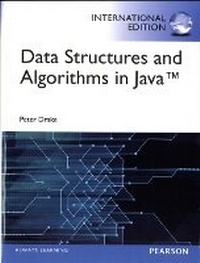
Data Structures and Algorithms in Java
International Edition
Published on 16. May 2013
Book
Paperback/Softback
592 pages
978-0-13-343768-3 (ISBN)
Description
An abundance of unique, interesting examples, use of the Unified Modeling Language throughout, and the newest Java 1.5 features characterize this text. Drake provides a concise and engaging introduction to Java and object-oriented programming, assuming familiarity with the basic control structures of Java or C and only a pre-calculus level of mathematics.
More details
Language
English
Place of publication
United States
Publishing group
Pearson Education (US)
Target group
College/higher education
Dimensions
Height: 180 mm
Width: 228 mm
Thickness: 28 mm
Weight
764 gr
ISBN-13
978-0-13-343768-3 (9780133437683)
Copyright in bibliographic data is held by Nielsen Book Services Limited or its licensors: all rights reserved.
Schweitzer Classification
Other editions
New editions
Book
11/2013
1st Edition
Pearson Education Limited
€99.49
Shipment within 10-20 days
Person
Peter Drake is Assistant Professor of Computer Science at Lewis &
Clark College in Portland, Oregon. He holds a BA in English from
Willamette University, an MS in Computer Science from Oregon State
University, and a PhD in Computer Science and Cognitive Science from
Indiana University. His research involves writing programs to play
the ancient Chinese game of Go.
Clark College in Portland, Oregon. He holds a BA in English from
Willamette University, an MS in Computer Science from Oregon State
University, and a PhD in Computer Science and Cognitive Science from
Indiana University. His research involves writing programs to play
the ancient Chinese game of Go.
Content
Note: Each chapter concludes with a summary, vocabulary, problems, and projects.
Part I: Object-Oriented Programming
1 Encapsulation. Software Development. Classes and Objects. Using Objects.
2 Polymorphism. Reference Types. Arrays. Interfaces. Overloading.
3 Inheritance. Extending a Class. The Object Class. Packages and Access Levels.
Part II: Linear Structures
4 Stacks and Queues. The Stack Interface. The Call Stack. Exceptions. The Queue Interface.
5 Array-Based Structures. Shrinking and Stretching Arrays. Implementing Stacks and Queues. The List Interface. Iterators. The Java Collections Framework: A First Look.
6 Linked Structures. List Nodes. Stacks and Queues. The LinkedList Class. The Java Collections Framework Revisited
Part III: Algorithms
7 Analysis of Algorithms. Timing. Asymptotic Notation. Counting Steps. Best, Worst, and Average Case. Amortized Analysis.
8 Searching and Sorting. Linear Search. Binary Search. Insertion Sort. The Comparable Interface. Sorting Linked Lists.
9 Recursion. Thinking Recursively. Analyzing Recursive Algorithms. Merge Sort. Quicksort. Avoiding Recursion.
Part IV: Trees and Sets
10 Trees. Binary Trees. Tree Traversal. General Trees
11 Sets. The Set Interface. Ordered Lists. Binary Search Trees. Hash Tables. The Java Collections Framework Again.
Part V: Advanced Topics
12 Advanced Linear Structures. Bit Vectors. Sparse Arrays. Contiguous Representation of Multidimensional Arrays. Advanced Searching and Sorting
13 Strings. Strings and StringBuilders. String Matching.
14 Advanced Trees. Heaps. Disjoint Set Clusters. Digital Search Trees. Red-Black Trees.
15 Graphs. Terminology. Representation. Graph Traversal. Topological Sorting. Shortest Paths. Minimum Spanning Trees.
16 Memory Management. Explicit Memory Management. Automatic Memory Management.
17 Out to the Disk. Interacting With Files. Compression. External Sorting. B-Trees.
Review of Java
Unified Modeling Language
Summation Formulae
Further Reading
Part I: Object-Oriented Programming
1 Encapsulation. Software Development. Classes and Objects. Using Objects.
2 Polymorphism. Reference Types. Arrays. Interfaces. Overloading.
3 Inheritance. Extending a Class. The Object Class. Packages and Access Levels.
Part II: Linear Structures
4 Stacks and Queues. The Stack Interface. The Call Stack. Exceptions. The Queue Interface.
5 Array-Based Structures. Shrinking and Stretching Arrays. Implementing Stacks and Queues. The List Interface. Iterators. The Java Collections Framework: A First Look.
6 Linked Structures. List Nodes. Stacks and Queues. The LinkedList Class. The Java Collections Framework Revisited
Part III: Algorithms
7 Analysis of Algorithms. Timing. Asymptotic Notation. Counting Steps. Best, Worst, and Average Case. Amortized Analysis.
8 Searching and Sorting. Linear Search. Binary Search. Insertion Sort. The Comparable Interface. Sorting Linked Lists.
9 Recursion. Thinking Recursively. Analyzing Recursive Algorithms. Merge Sort. Quicksort. Avoiding Recursion.
Part IV: Trees and Sets
10 Trees. Binary Trees. Tree Traversal. General Trees
11 Sets. The Set Interface. Ordered Lists. Binary Search Trees. Hash Tables. The Java Collections Framework Again.
Part V: Advanced Topics
12 Advanced Linear Structures. Bit Vectors. Sparse Arrays. Contiguous Representation of Multidimensional Arrays. Advanced Searching and Sorting
13 Strings. Strings and StringBuilders. String Matching.
14 Advanced Trees. Heaps. Disjoint Set Clusters. Digital Search Trees. Red-Black Trees.
15 Graphs. Terminology. Representation. Graph Traversal. Topological Sorting. Shortest Paths. Minimum Spanning Trees.
16 Memory Management. Explicit Memory Management. Automatic Memory Management.
17 Out to the Disk. Interacting With Files. Compression. External Sorting. B-Trees.
Review of Java
Unified Modeling Language
Summation Formulae
Further Reading