

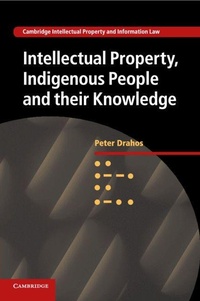
Intellectual Property, Indigenous People and their Knowledge
Published on 16. April 2020
Book
Paperback/Softback
262 pages
978-1-107-68694-6 (ISBN)
Description
After colonization, indigenous people faced an extractive property rights regime for both their land and knowledge. This book outlines that regime, and how the symbolic function of international intellectual property continues today to assist states to enclose indigenous peoples' knowledge. Drawing on more than 200 interviews, Peter Drahos examines the response of indigenous people to the colonizer's non-developmental property rights. The case studies reveal how they have adapted to the state's extractive order through a process of regulatory bricolage. In order to create a new developmental future for themselves, indigenous developmental networks have been forged - high trust networks that include partnerships with science. Intellectual Property, Indigenous People and their Knowledge argues for a developmental intellectual property order for indigenous people based on a combination of simple rules, principles and a process of regulatory convening.
More details
Series
Language
English
Place of publication
Cambridge
United Kingdom
Target group
Professional and scholarly
Product notice
Paperback (trade)
Dimensions
Height: 229 mm
Width: 152 mm
Thickness: 14 mm
Weight
385 gr
ISBN-13
978-1-107-68694-6 (9781107686946)
Copyright in bibliographic data and cover images is held by Nielsen Book Services Limited or by the publishers or by their respective licensors: all rights reserved.
Schweitzer Classification
Other editions
Additional editions
Book
06/2014
Cambridge University Press
€133.10
Shipment within 15-20 days
Person
Peter Drahos is a professor at the Australian National University and holds a Chair in Intellectual Property at Queen Mary, University of London. He is a member of the Australian Academy of Social Sciences.
Content
1. The non-developmental state; 2. Cosmology's country; 3. Loss; 4. Symbolic recognition; 5. Rules and the recognition of ancestors; 6. The Kimberley: big projects, little projects; 7. Secret plants; 8. Paying peanuts for biodiversity; 9. Gentle on country, gentle on people; 10. Protecting country's cosmology; 11. Trust in networks.