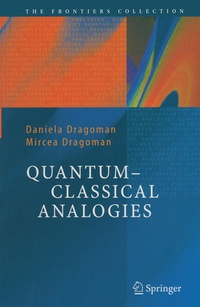
It is unanimously accepted that the quantum and the classical descriptions of the physical reality are very different, although any quantum process is "mysteriously" transformed through measurement into an observable classical event. Beyond the conceptual differences, quantum and classical physics have a lot in common. And, more important, there are classical and quantum phenomena that are similar although they occur in completely different contexts. For example, the Schrödinger equation has the same mathematical form as the Helmholtz equation, there is an uncertainty relation in optics very similar to that in quantum mechanics, and so on; the list of examples is very long. Quantum-classical analogies have been used in recent years to study many quantum laws or phenomena at the macroscopic scale, to design and simulate mesoscopic devices at the macroscopic scale, to implement quantum computer algorithms with classical means, etc. On the other hand, the new forms of light - localized light, frozen light - seem to have more in common with solid state physics than with classical optics. So these analogies are a valuable tool in the quest to understand quantum phenomena and in the search for new (quantum or classical) applications, especially in the area of quantum devices and computing.
Reviews / Votes
From the reviews:
"The main role of quantum classical analogies presented in ten distinct chapters is to shed some light on the genuine significance of the quantum and classical worlds. . The book addresses a large category of readers, especially graduates and PhD students . . The book is also useful for researchers working in advanced topics . . It can be used as an additional source for a course on quantum mechanics . . The hard cover book is nicely edited . ." (Roland Carchon, Physicalia, Vol. 57 (3), 2005)
"The authors . devote their new book to the striking analogies between classical and quantum physics. . the authors wish to show that the classical and quantum worlds share many common concepts despite striking differences. . The wealth of analogies . discovered and presented in ten distinct chapters sheds some light on the genuine significance of both the quantum world and its classical counterpart. The book addresses students and researchers alike specialising in the study of quantum devices, atom optics or quantum optics." (Gert Roepstorff, Zentralblatt MATH, Vol. 1093 (19), 2006)
"Analogies are a powerful cognitive tool that allow us to make inferences and learn new aspects from the comparison of two things by highlighting their similarities. . It is important to mention that the book is intended to be a catalogue of phenomena shared between classical and quantum physics . . the references given are an invaluable asset. . This book is therefore a very good choice for those interested in bridging ideas from classical physics into the quantum world or vice versa." (Dr. J. Rogel-Salazar, Contemporary Physics, Vol. 46 (6), 2005)
"This book develops and explores in a systematic manner a large number of analogs between quantum and classical theories. . It follows closely the recent experimental developments, and for each chapter there is a large number of current references. . Itwill be very valuable for a large category of readers ranging from graduate and Ph. D. students to researchers working in these areas, and on to teachers looking for nontrivial modern applications and developments in both quantum and classical physics." (Vitor R. Vieira, Mathematical Reviews, Issue 2007 c)
Series
Edition
Softcover reprint of hardcover 1st ed. 2004
Language
Place of publication
Publishing group
Target group
Professional and scholarly
Research
Illustrations
Dimensions
Height: 235 mm
Width: 155 mm
Thickness: 20 mm
Weight
ISBN-13
978-3-642-05766-3 (9783642057663)
DOI
10.1007/978-3-662-09647-5
Schweitzer Classification
Mircea Dragoman was born in Bucharest in 1955. He graduated the Polytechnical Institute in Bucharest, Electronic Faculty, in 1980. He received the doctoral degree in electronics in 1991. He is a senior researcher I at the National Research Institute in Microtechnologies, since 1996. He is teaching since 2008 at Univ. Poltehnica Bucharest ,Romania a course termed Advanced Technological Processes which related to nanotechnologies and advanced materials. He has realized the first carbon nanotube and graphene devices and circuits for high frequency applications enriching the novel area of Carbon-based Electronics. In the period 1992-1994 he was the recipient of the Humbold Fellowship award and he has followed postdoctoral studies at Duisburg University, Germany. He was invited professor at : CNR- Istituto di Electtronica dello Stato Solido-Roma (1996), Univ. Saint-Etienne -Franta (1997), Univ. Mannheim (1998-1999, 2001-2002), Univ. Frankfurt (2003), Univ. Darmstadt (2004); in the period 2005-2006, 2008-2010 he was nominated directeur de recherche at CNRS LAAS Toulouse. He has published more than 250 scientific papers in the following areas : nanoelectronics, microwaves, MEMS, optoelectronics. He eceived the "Gheorghe Cartianu" award of the Romanian Academy in 1999.He is co-author of the following books: D. Dragoman, M. Dragoman "Advanced Optoelectronic Devices", Springer (1999),D. Dragoman, M. Dragoman, "Optical Characterization of Solids, Springer (2002),st edition,420 pages i,( 2006), second edition (2008).D.Dragoman, M.Dragoman, Bionanoelectronics, Springer 2012. D.Dragoman and M.Dragoman, Sheng Wu Na Mi Dian Zi Xu (Bionanolectronics, Chinesse Edition, Science Press (2015).
Daniela Dragoman graduated the University of Bucharest, Physics Faculty, in 1989 and received the PhD degree from the University of Limerick, in 1993. She is Professor at the Physics Faculty, University of Bucharest. She teaches Solid State Physics and Nanophysics courses at the undergraduate and postgraduate levels. Her areas of interests include the physics and applications of nanostructures, with a particular emphasis of carbon nanotubes and graphene, and modeling of quantum nanoscale devices. She was the recipient of the Alexander von Humboldt fellowship during Feb. 1998-June 1999 and Sept. 2001-March 2002, when she worked at the Univ. of Mannheim, Germany, and occupied the position of Directeur de Recherche at LAAS-CNRS, Toulouse, France during July-September 2008, 2009, and 2010. She was also visiting professor at several universities in France, Germany, and Italy.
Daniela Dragoman has published more than 270 scientific papers in areas including quantum and classical optics, quantum mechanics, and nanostructures. She co-authored the books Advanced Optoelectronic Devices (1999), Optical Characterization of Solids (2002), Quantum-Classical Analogies (2004) and Bionanoelectronics (2012, with an edition in 2014 at China Science Publishing and Media Inc.) published by Springer, and Nanoelectronics: Principles and Devices (1st edition in 2006 and 2nd edition in 2008) published by Artech House, as well as other book chapters. She received the "Gheorghe Cartianu" award of the Romanian Academy in 1999, for the book Advanced Optoelectronic Devices (Springer).
1 Introduction.- 2 Analogies Between Ballistic Electrons and Electromagnetic Waves.- 3 Electron/Electromagnetic Multiple Scattering and Localization.- 4 Acoustic Analogies for Quantum Mechanics.- 5 Optical Analogs for Multilevel Quantum Systems.- 6 Particle Optics.- 7 Quantum/Classical Nonlinear Phenomena.- 8 Quantum/Classical Phase Space Analogies.- 9 Analogies Between Quantum and Classical Computing.- 10 Other Quantum/Classical Analogies.- References.