

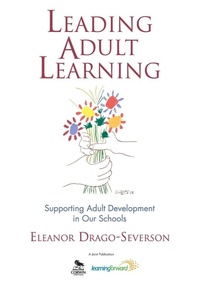
Leading Adult Learning
Supporting Adult Development in Our Schools
1st Edition
Published on 8. December 2009
Book
Paperback/Softback
368 pages
978-1-4129-5072-5 (ISBN)
Description
"Eleanor Drago-Severson takes hold of an important and neglected truth: students grow best in schools where the adults around them are growing, too. In this nurturing and much-anticipated work, the author shows us exactly how to make this happen. Sound theory, vivid examples, and, best of all, a practice-ready framework-it's all here! Anyone who cares about making our schools better will feel richly rewarded for spending time with this encouraging book."
-Robert Kegan, Meehan Professor of Adult Learning and Professional Development
Harvard University Graduate School of Education
Coauthor of Immunity to Change
"With this comprehensive and compelling book, Eleanor Drago-Severson establishes herself as a leading authority on authoritative leadership in education."
-Howard Gardner, Author of Leading Minds
Support the growth and development of all adults-teachers, principals, and superintendents-in your school community!
Educators at every level go through different stages of development over the course of their lives and need different kinds of supports and challenges to grow. Leading Adult Learning introduces a model of adult development that helps school and district leaders consciously cultivate teacher, principal, and superintendent capacities in the educational workplace.
Eleanor Drago-Severson's developmental model of learning-oriented school leadership draws from multiple knowledge domains, including adult learning, developmental theory, leadership practice, and organizational collaboration. The book shows school leaders how to foster growth and learning for individuals with different needs and developmental orientations. With a focus on research and application, this volume:
Details four Pillar Practices for growth-teaming, providing leadership roles, collegial inquiry, and mentoring-which can support all adults
Presents extensive research and practical application from principals, teachers, superintendents, and other school leaders from across the nation
Includes application exercises, reflective questions, and lessons from the field to assist you in applying this learning-oriented model to your school and school system
Drago-Severson makes a compelling case for deliberately supporting adult development within and across school systems to enhance adults' capacities, school improvement, and student achievement.
-Robert Kegan, Meehan Professor of Adult Learning and Professional Development
Harvard University Graduate School of Education
Coauthor of Immunity to Change
"With this comprehensive and compelling book, Eleanor Drago-Severson establishes herself as a leading authority on authoritative leadership in education."
-Howard Gardner, Author of Leading Minds
Support the growth and development of all adults-teachers, principals, and superintendents-in your school community!
Educators at every level go through different stages of development over the course of their lives and need different kinds of supports and challenges to grow. Leading Adult Learning introduces a model of adult development that helps school and district leaders consciously cultivate teacher, principal, and superintendent capacities in the educational workplace.
Eleanor Drago-Severson's developmental model of learning-oriented school leadership draws from multiple knowledge domains, including adult learning, developmental theory, leadership practice, and organizational collaboration. The book shows school leaders how to foster growth and learning for individuals with different needs and developmental orientations. With a focus on research and application, this volume:
Details four Pillar Practices for growth-teaming, providing leadership roles, collegial inquiry, and mentoring-which can support all adults
Presents extensive research and practical application from principals, teachers, superintendents, and other school leaders from across the nation
Includes application exercises, reflective questions, and lessons from the field to assist you in applying this learning-oriented model to your school and school system
Drago-Severson makes a compelling case for deliberately supporting adult development within and across school systems to enhance adults' capacities, school improvement, and student achievement.
Reviews / Votes
"With this comprehensive and compelling book, Eleanor Drago-Severson establishes herself as a leading expert on authoritative leadership in education." -- Howard Gardner, Author of Leading Minds "As complete a primer for leading adult learning as can be found in print today. Each chapter includes cases and lessons from the field and reflective questions. Eleanor Drago-Severson combines research and practice to create an essential handbook for leaders of adults." -- The School Administrator Magazine, January 2011 "Eleanor Drago-Severson takes hold of an important and neglected truth: students grow best in schools where the adults around them are growing, too. In this nurturing and much-anticipated work, the author shows us exactly how to make this happen. Sound theory, vivid examples, and a practice-ready framework-it's all here! Anyone who cares about making our schools better will feel richly rewarded for spending time with this encouraging book." -- Robert Kegan, Meehan Professor of Adult Learning and Professional Development "There is no greater opportunity for improving public education than to make schools places where adults learn and lead together. In her rich and engaging book, Drago-Severson explores the challenge of this important work and shows us how success is both possible and deeply rewarding." -- Susan Moore Johnson, Pforzheimer Professor of Teaching and Learning "Building on the 'pillar practices' of her earlier work and animated with stories, exercises, and illustrations, this book offers both lucid explication of the powerful insights of constructive developmental theory and intensely practical partnership in how to put it all to work on Monday morning. In these hard times, this is a welcome and hopeful blueprint for the reanimation of our schools and the transformation of our communities." -- Laurent A. Parks Daloz, Senior FellowMore details
Language
English
Place of publication
Thousand Oaks
United States
Publishing group
SAGE Publications Inc
Target group
Professional and scholarly
Dimensions
Height: 254 mm
Width: 178 mm
Thickness: 20 mm
Weight
692 gr
ISBN-13
978-1-4129-5072-5 (9781412950725)
Copyright in bibliographic data and cover images is held by Nielsen Book Services Limited or by the publishers or by their respective licensors: all rights reserved.
Schweitzer Classification
Other editions
New editions
Book
approx. 11/2026
2nd Edition
Corwin Press Inc
€60.91
Not yet published
Additional editions
Book
12/2009
1st Edition
Corwin Press Inc
€96.90
Shipment within 10-20 days
Person
Eleanor-Ellie-Drago-Severson is Professor of Education Leadership and Adult Learning and Leadership at Teachers College, Columbia University. A developmental psychologist, Ellie teaches, conducts research, and consults with team, school, district, and systems leaders-as well as teacher leaders-in public, charter, and private schools and systems. She supports professional and personal growth; leadership development for principals, assistant principals, teachers, schools, districts, and organizations; and coaching and mentoring in K-12 schools, universities, medical institutions, educational associations, and other adult education contexts both domestically and internationally. She is also an internationally certified developmental coach who partners with leaders to build internal capacity, lead on behalf of social justice, and strengthen capacity across their systems.
For more than three decades, Ellie's teaching, research, and partnerships in the field have sought-synergistically-to explore and extend the possibilities of adult development and developmental leadership as levers for internal capacity building at the individual, team, organizational, and societal levels. Her work explores interconnected streams that focus on the connection between internal capacities and educational leaders'-broadly and inclusively defined-practice on behalf of growing bigger selves and helping others to do the same. She also takes a developmental approach to creating conditions that support our desires to thrive and support those in our care, as well as feedback for growth, the pressing challenges national and international educational leaders are facing and ways to help them manage these challenges, and leadership preparation and development. In addition, her work offers a new, learning-oriented model for leadership development; supports adult development in individuals and teams within and across systems; lifts leadership at the individual and systems levels; supports diverse adult English language learners and those who serve them; and grows teacher, principal, assistant principal and district-level leadership.
Consonant with urgent conversations about transforming teams, schools, systems, and society into more learning-inclusive and equity-oriented contexts, her work foregrounds how we can support leaders' internal capacity building in schools, districts, organizations, and leadership preparation programs-and how these capacities inform the gifts leaders are able to give to those in their care, each other, and the world as they lead for social justice and strive to make the world a better place for all. Ellie loves opportunities to accompany educators and other leaders in their vital work-and never takes it for granted. Instead, she considers it a gift.
At Teachers College, Ellie is director of the PhD Program in Educational Leadership. She teaches aspiring and practicing principals in the Summer Principals Academy; aspiring superintendents in the Urban Education Leaders Program; and leaders from a range of for-profit, management, and consulting sectors in the Accelerated Education Guided Intensive Study (AEGIS) Program. She also coaches leaders in the Cahn Fellows Program for Distinguished Leaders and in her private coaching practice to help them grow-on the inside-and to grow their practice. In addition, she serves as faculty director and co-facilitator of the Leadership Institute for School Change at Teachers College.
Ellie is author of the best-selling books Helping Teachers Learn: Principal Leadership for Adult Growth and Development (Corwin, 2004) and Leading Adult Learning: Supporting Adult Development in Our Schools (Corwin/The National Staff Development Council, 2009), as well as Becoming Adult Learners: Principles and Practice for Effective Development (Teachers College Press, 2004) and Helping Educators Grow: Strategies and Practices for Leadership Development (Harvard Education Press, 2012). She is also coauthor of Learning for Leadership: Developmental Strategies for Building Capacity in Our Schools (Corwin, 2013), Reach the Highest Standard in Professional Learning: Learning Designs (Learning Forward & Corwin, 2014), Tell Me So I Can Hear You: A Developmental Approach to Feedback for Educators (Harvard Education Press, 2016), Leading Change Together: Developing Educator Capacity Within Schools and Systems (ASCD, 2018) and Growing for Justice: A Developmental Continuum of Leadership Capacities and Practices (Corwin/Sage & Learning Forward, 2023).
Ellie's teaching, scholarship, and developmental approach to leadership foreground the power of growth, relationships, and interconnections-since these are essential to learning, development, individual perspective broadening, authentic collaboration, and capacity building at the individual, team, school, district, and systems levels. Her teaching, mentoring, and life's work are inspired by her husband and soulmate, her parents and family, her relationships, her teachers, her own experiences as a middle and high school teacher, her experiences as a program director and teacher of adults, her work with leaders in the field, her coaching work, and-last but not least-her work with practicing and aspiring leaders in graduate programs and in the field. Taken together, these experiences form an interdisciplinary palette that is complemented by adult developmental theories and other life-changing frameworks.
Ellie's work has earned awards from the Spencer Foundation, the Klingenstein Foundation, and Harvard University, where she served on faculty for eight years and was awarded the Morningstar Award for Excellence in Teaching and the Dean's Award for Excellent in Teaching. Most recently, Ellie received three outstanding teaching awards from Columbia University. She earned degrees from Long Island University (BA) and Harvard University (EdM, EdD, and a postdoctoral fellowship). Ellie grew up in the Bronx and is deeply grateful for the ways that it-and the community that raised her-have shaped her life.
For more than three decades, Ellie's teaching, research, and partnerships in the field have sought-synergistically-to explore and extend the possibilities of adult development and developmental leadership as levers for internal capacity building at the individual, team, organizational, and societal levels. Her work explores interconnected streams that focus on the connection between internal capacities and educational leaders'-broadly and inclusively defined-practice on behalf of growing bigger selves and helping others to do the same. She also takes a developmental approach to creating conditions that support our desires to thrive and support those in our care, as well as feedback for growth, the pressing challenges national and international educational leaders are facing and ways to help them manage these challenges, and leadership preparation and development. In addition, her work offers a new, learning-oriented model for leadership development; supports adult development in individuals and teams within and across systems; lifts leadership at the individual and systems levels; supports diverse adult English language learners and those who serve them; and grows teacher, principal, assistant principal and district-level leadership.
Consonant with urgent conversations about transforming teams, schools, systems, and society into more learning-inclusive and equity-oriented contexts, her work foregrounds how we can support leaders' internal capacity building in schools, districts, organizations, and leadership preparation programs-and how these capacities inform the gifts leaders are able to give to those in their care, each other, and the world as they lead for social justice and strive to make the world a better place for all. Ellie loves opportunities to accompany educators and other leaders in their vital work-and never takes it for granted. Instead, she considers it a gift.
At Teachers College, Ellie is director of the PhD Program in Educational Leadership. She teaches aspiring and practicing principals in the Summer Principals Academy; aspiring superintendents in the Urban Education Leaders Program; and leaders from a range of for-profit, management, and consulting sectors in the Accelerated Education Guided Intensive Study (AEGIS) Program. She also coaches leaders in the Cahn Fellows Program for Distinguished Leaders and in her private coaching practice to help them grow-on the inside-and to grow their practice. In addition, she serves as faculty director and co-facilitator of the Leadership Institute for School Change at Teachers College.
Ellie is author of the best-selling books Helping Teachers Learn: Principal Leadership for Adult Growth and Development (Corwin, 2004) and Leading Adult Learning: Supporting Adult Development in Our Schools (Corwin/The National Staff Development Council, 2009), as well as Becoming Adult Learners: Principles and Practice for Effective Development (Teachers College Press, 2004) and Helping Educators Grow: Strategies and Practices for Leadership Development (Harvard Education Press, 2012). She is also coauthor of Learning for Leadership: Developmental Strategies for Building Capacity in Our Schools (Corwin, 2013), Reach the Highest Standard in Professional Learning: Learning Designs (Learning Forward & Corwin, 2014), Tell Me So I Can Hear You: A Developmental Approach to Feedback for Educators (Harvard Education Press, 2016), Leading Change Together: Developing Educator Capacity Within Schools and Systems (ASCD, 2018) and Growing for Justice: A Developmental Continuum of Leadership Capacities and Practices (Corwin/Sage & Learning Forward, 2023).
Ellie's teaching, scholarship, and developmental approach to leadership foreground the power of growth, relationships, and interconnections-since these are essential to learning, development, individual perspective broadening, authentic collaboration, and capacity building at the individual, team, school, district, and systems levels. Her teaching, mentoring, and life's work are inspired by her husband and soulmate, her parents and family, her relationships, her teachers, her own experiences as a middle and high school teacher, her experiences as a program director and teacher of adults, her work with leaders in the field, her coaching work, and-last but not least-her work with practicing and aspiring leaders in graduate programs and in the field. Taken together, these experiences form an interdisciplinary palette that is complemented by adult developmental theories and other life-changing frameworks.
Ellie's work has earned awards from the Spencer Foundation, the Klingenstein Foundation, and Harvard University, where she served on faculty for eight years and was awarded the Morningstar Award for Excellence in Teaching and the Dean's Award for Excellent in Teaching. Most recently, Ellie received three outstanding teaching awards from Columbia University. She earned degrees from Long Island University (BA) and Harvard University (EdM, EdD, and a postdoctoral fellowship). Ellie grew up in the Bronx and is deeply grateful for the ways that it-and the community that raised her-have shaped her life.
Content
Preface
Acknowledgments
About the Author
Part 1. Foundations
1. A New Model of Leadership for Adult Growth and Learning
In This Chapter
Meeting Adaptive Challenges
The Need for a New Model of Leadership
Supporting Learning Across the System
Re-envisioning Staff Development
The Research Informing This Book
A New Learning-Oriented Model of School Leadership
Organization of the Book
Summary and Conclusion
Reflective Questions
2. How Constructive-Developmental Theory Informs the Pillar Practices
Why Constructive-Developmental Theory?
Informational Learning vs Transformational Learning
Constructive-Developmental Theory: An Introduction
Why Ways of Knowing Matter When Supporting Adult Growth
Shaping School Cultures: Noble Expectations and Hidden Developmental Demands
The Holding Environment and Why It Matters in Schools
The Learning-Oriented Leadership Model
Chapter Summary
Frequently Asked Questions
Application Exercise
Reflective Questions
Part 2. Pillar Practices for Growth
3. Teaming: Growth Opportunities for Individuals, Organizations, and Systems
About Effective Teaming and Its Value
Key Elements of Successful Teaming
The Team as a Source of Individual Growth and Development
Why and How School Leaders Employ Teaming
Team Structures That Nurture Adult Development
Implementing Teaming: Lessons From the Field
Chapter Summary
Frequently Asked Questions
Application Exercise
Reflective Questions
4. Providing Leadership Roles: Learning and Growing From Leading Together
About Providing Leadership Roles
Developmental Benefits of Providing Leadership Roles
Examples of School Leaders? Use of Providing Leadership Roles
Cases and Lessons From the Field
Chapter Summary
Reflective Questions
5. Collegial Inquiry: Engaging in Shared Dialogue and Reflection on Practice
Collegial Inquiry: A Kind of Reflective Practice
Collaborative Cultures
How Collegial Inquiry Attends to Developmental Diversity
Why and How School Leaders Employ Collegial Inquiry
Practices School Leaders Use to Initiate Collegial Inquiry
Case Study: One Principal?s ?Rare and Unique Opportunity? to Engage in Reflective Practice Over Time
Convenings: Personal Case-Based Discussions That Support Collegial Inquiry
Chapter Summary
Application Exercises
Reflective Questions
6. Mentoring: Building Meaningful and Growth-Enhancing Relationships
About Effective Mentoring and Its Value
Mentoring and Developmental Diversity
Implications: How Our Way of Knowing Influences the Way We Mentor
Why and How School Leaders Employ Mentoring
An Example of a Mentoring Program: Lessons From the Field
A Protocol for Mentoring Relationships That Nurture Adult Development
Chapter Summary
Application Exercise
Reflective Questions
7. Implementing the Pillar Practices: Cases From the Field
Case 1: Mentoring Principals and Assistant Principals
Case 2: Coaching School Leaders
Case 3: Leading Teachers by Listening
Case 4: Supporting Adult Development Through Schoolwide Transformation
Case 5: The Pillar Practices, Hawaiian Style
Chapter Summary
Application Exercise
Reflective Questions
8. The School as Learning Center: Stepping Forward With Hope
Meeting Adaptive Challenges by Building Developmental Capacity
The Promise of Building Schools as Learning Centers
Implications of the New Learning-Oriented Leadership Model
Attending to and Valuing Adults? Ways of Knowing
Putting the New Learning-Oriented Model Into Practice
Stepping Forward
On the Gift of Giving
Research Appendix
Glossary
Endnotes
References
Index
Acknowledgments
About the Author
Part 1. Foundations
1. A New Model of Leadership for Adult Growth and Learning
In This Chapter
Meeting Adaptive Challenges
The Need for a New Model of Leadership
Supporting Learning Across the System
Re-envisioning Staff Development
The Research Informing This Book
A New Learning-Oriented Model of School Leadership
Organization of the Book
Summary and Conclusion
Reflective Questions
2. How Constructive-Developmental Theory Informs the Pillar Practices
Why Constructive-Developmental Theory?
Informational Learning vs Transformational Learning
Constructive-Developmental Theory: An Introduction
Why Ways of Knowing Matter When Supporting Adult Growth
Shaping School Cultures: Noble Expectations and Hidden Developmental Demands
The Holding Environment and Why It Matters in Schools
The Learning-Oriented Leadership Model
Chapter Summary
Frequently Asked Questions
Application Exercise
Reflective Questions
Part 2. Pillar Practices for Growth
3. Teaming: Growth Opportunities for Individuals, Organizations, and Systems
About Effective Teaming and Its Value
Key Elements of Successful Teaming
The Team as a Source of Individual Growth and Development
Why and How School Leaders Employ Teaming
Team Structures That Nurture Adult Development
Implementing Teaming: Lessons From the Field
Chapter Summary
Frequently Asked Questions
Application Exercise
Reflective Questions
4. Providing Leadership Roles: Learning and Growing From Leading Together
About Providing Leadership Roles
Developmental Benefits of Providing Leadership Roles
Examples of School Leaders? Use of Providing Leadership Roles
Cases and Lessons From the Field
Chapter Summary
Reflective Questions
5. Collegial Inquiry: Engaging in Shared Dialogue and Reflection on Practice
Collegial Inquiry: A Kind of Reflective Practice
Collaborative Cultures
How Collegial Inquiry Attends to Developmental Diversity
Why and How School Leaders Employ Collegial Inquiry
Practices School Leaders Use to Initiate Collegial Inquiry
Case Study: One Principal?s ?Rare and Unique Opportunity? to Engage in Reflective Practice Over Time
Convenings: Personal Case-Based Discussions That Support Collegial Inquiry
Chapter Summary
Application Exercises
Reflective Questions
6. Mentoring: Building Meaningful and Growth-Enhancing Relationships
About Effective Mentoring and Its Value
Mentoring and Developmental Diversity
Implications: How Our Way of Knowing Influences the Way We Mentor
Why and How School Leaders Employ Mentoring
An Example of a Mentoring Program: Lessons From the Field
A Protocol for Mentoring Relationships That Nurture Adult Development
Chapter Summary
Application Exercise
Reflective Questions
7. Implementing the Pillar Practices: Cases From the Field
Case 1: Mentoring Principals and Assistant Principals
Case 2: Coaching School Leaders
Case 3: Leading Teachers by Listening
Case 4: Supporting Adult Development Through Schoolwide Transformation
Case 5: The Pillar Practices, Hawaiian Style
Chapter Summary
Application Exercise
Reflective Questions
8. The School as Learning Center: Stepping Forward With Hope
Meeting Adaptive Challenges by Building Developmental Capacity
The Promise of Building Schools as Learning Centers
Implications of the New Learning-Oriented Leadership Model
Attending to and Valuing Adults? Ways of Knowing
Putting the New Learning-Oriented Model Into Practice
Stepping Forward
On the Gift of Giving
Research Appendix
Glossary
Endnotes
References
Index