

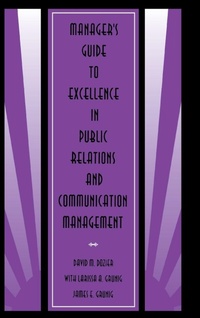
Manager's Guide to Excellence in Public Relations and Communication Management
1st Edition
Published on 1. July 1995
Book
Hardback
270 pages
978-0-8058-1809-3 (ISBN)
Description
This book reports findings of a three-nation study of public relations and communication management sponsored by the International Association of Business Communicators (IABC) Research Foundation. The Excellence Study provides communication managers and public relations practitioners with information critical to their own professional growth, and supplies organizations with tools that help them communicate more effectively and build beneficial relations with key publics. Communication excellence is a powerful idea of sweeping scope that applies to all organizations -- large or small -- that need to communicate effectively with publics on whom the organization's survival and growth depend. The essential elements of excellent communication are the same for corporations, not-for-profit organizations, government agencies, and professional/trade associations. And they are applicable on a global basis.
The study identifies three spheres of communication excellence. These spheres consider the overall function and role of communication in organizations, and define the organization of this book. They are:
* the core or inner sphere of communication excellence -- the knowledge base of the communication department,
* the shared expectations of top communicators and senior managers about the function and role of communication, and
* the organization's culture -- the larger context that either nurtures or impedes communication excellence.
This text also examines communication excellence as demonstrated in specific programs developed for specific publics.
The study identifies three spheres of communication excellence. These spheres consider the overall function and role of communication in organizations, and define the organization of this book. They are:
* the core or inner sphere of communication excellence -- the knowledge base of the communication department,
* the shared expectations of top communicators and senior managers about the function and role of communication, and
* the organization's culture -- the larger context that either nurtures or impedes communication excellence.
This text also examines communication excellence as demonstrated in specific programs developed for specific publics.
More details
Series
Language
English
Place of publication
New York
United States
Publishing group
Taylor & Francis Inc
Target group
Professional and scholarly
Dimensions
Height: 235 mm
Width: 157 mm
Thickness: 19 mm
Weight
549 gr
ISBN-13
978-0-8058-1809-3 (9780805818093)
Copyright in bibliographic data and cover images is held by Nielsen Book Services Limited or by the publishers or by their respective licensors: all rights reserved.
Schweitzer Classification
Other editions
Additional editions
David M. Dozier | Larissa A. Grunig | James E. Grunig
Manager's Guide to Excellence in Public Relations and Communication Management
E-Book
10/2013
1st Edition
Routledge
€68.49
Available for download
David M. Dozier | Larissa A. Grunig | James E. Grunig
Manager's Guide to Excellence in Public Relations and Communication Management
E-Book
10/2013
1st Edition
Routledge
€68.49
Available for download
David M. Dozier | Larissa A. Grunig | James E. Grunig
Manager's Guide to Excellence in Public Relations and Communication Management
Book
07/1995
1st Edition
Routledge
€74.60
Shipment within 10-20 days
Persons
Dozier, David M.; Grunig, Larissa A.; Grunig, James E.
Content
Contents: Preface. What Is Communication Excellence? Part I: Communicator Knowledge Base. Knowing How to Manage Strategically. Knowing Two-Way Communication Practices. Knowing Traditional Communicator Skills. Build Your Knowledge Base. Part II: Shared Expectations About Communication. The Power of the Communication Department. Shared Expectations of Communication. Building Linkages to the Dominant Coalition. What CEOs Should Do About Excellence. Part III: The Character of Organizations. Participation and Authority in the Culture of Organizations. Empowering Women and Culturally Diverse Employees. The Global Qualities of Excellence. Changing the Character of Organizations. Part IV: Putting Excellence to Work. Origins of Communication Programs. Using Traditional and Advanced Practices. Communication Excellence Makes a Difference. Appendix: How the Excellence Study Was Conducted.