

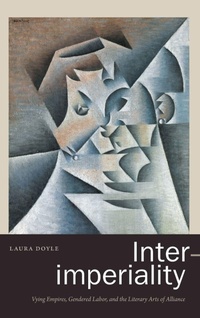
Inter-imperiality
Vying Empires, Gendered Labor, and the Literary Arts of Alliance
Published on 11. December 2020
Book
Hardback
392 pages
978-1-4780-1004-3 (ISBN)
Description
In Inter-imperiality Laura Doyle theorizes the co-emergence of empires, institutions, language regimes, stratified economies, and literary cultures over the longue durEe. Weaving together feminist, decolonial, and dialectical theory, she shows how inter-imperial competition has generated a systemic stratification of gendered, racialized labor, while literary and other arts have helped both to constitute and to challenge this world order. To study literature is therefore, Doyle argues, to attend to world-historical processes of imaginative and material co-formation as they have unfolded through successive eras of vying empires. It is also to understand oral, performed, and written literatures as power-transforming resources for the present and future. To make this case, Doyle analyzes imperial-economic processes across centuries and continents in tandem with inter-imperially entangled literatures, from A Thousand and One Nights to recent Caribbean fiction. Her trenchant interdisciplinary method reveals the structural centrality of imaginative literature in the politics and possibilities of earthly life.
Reviews / Votes
"Notable for its recognition of the crucial, but often ignored, dialectical relationship between political economy and literary production, Inter-imperiality provides powerful examples of how a scholar can engage with one problematic across disciplines, using literary texts as an anchor. This big, bold book is a major intervention in continuing debates on the emergence of literature in relation to a world defined by the phenomenon of empires of time and space." - Simon Gikandi, author of (Slavery and the Culture of Taste) "[Inter-imperiality] offers a transhistorical, interdisciplinary, intersectional, and decolonial analysis of the fundamentally relational processes that constitute imperial powers and individual lives. Polities and persons alike are enmeshed in shifting entanglements that enable coercion and violence as well as care and community. Aiming to 'honor the struggles and the sustaining practices' that are elided when this existential interdependence is disavowed, Doyle chronicles a longue durEe of dialectical state and identity (co)formation that spans the eleventh to the twentieth centuries." (American Literature) "Inter-imperiality might be described as an attempt to reiterate the ontological insights of Hegel regarding the dialectical truth of our lived identity, extended and expanded through the longue durEe of Braudel, but couched crucially in the terminology of feminist, Marxist, and postcolonial thought. It is a paean, among other things, to the untold history of female, non-Western labor. . . . There is a fervor and a seriousness to Doyle's desire to expand and decenter contemporary global historiography, which is inspiring to read." - Ian Almond (Comparative Literature) "How did European colonialism happen? Why is racism still permeating many quarters of life? How can we prevent the existence of colonialism and racism? Inter-imperiality innovatively engages these questions. . . . Doyle's call for a return to the avowal of the materialist dialectic and for 'care, and cure' presents inspiring new ways for thinking about the future of decolonial studies." - Lidan Lin (Modern Fiction Studies) "Among the most important books in literary studies in the last decade, Laura Doyle's Inter-imperiality deserves sustained attention. Situated between comparative literary studies, world history, decolonial theory and gender studies, Inter-Imperiality recasts literary history as a counterpoint to the world history of empires. Profoundly interdisciplinary, it makes a forceful case for the relevance of literary analysis to the comparative study of empires-and coloniality." - Anca Parvulescu (Modernism/Modernity)More details
Language
English
Place of publication
North Carolina
United States
Target group
Professional and scholarly
Product notice
Cloth over boards
Dimensions
Height: 235 mm
Width: 157 mm
Thickness: 26 mm
Weight
717 gr
ISBN-13
978-1-4780-1004-3 (9781478010043)
Copyright in bibliographic data and cover images is held by Nielsen Book Services Limited or by the publishers or by their respective licensors: all rights reserved.
Schweitzer Classification
Other editions
Additional editions
E-Book
11/2020
1st Edition
De Gruyter
€218.99
Available for download
Person
Laura Doyle is Professor of English at the University of Massachusetts-Amherst and author of several books, including Freedom's Empire: Race and the Rise of the Novel in Atlantic Modernity, 1640-1940, also published by Duke University Press.
Content
Acknowledgments ix
Theoretical Introduction. Between States 1
Part I. Co-Constituted Worlds
1. Dialectics in the Longue DurEe 35
2. Refusing Labor's (Re)production in The Thousand and One Nights 68
Part II. Convergence and Revolt
3. Remapping Orientalism among Eurasian Empires 95
4. Global Revolts and Gothic Interventions 121
5. Infrastructure, Activism, and Literary Dialectics in the Early Twentieth Century 156
Part III. Persisting Temporalities
6. Rape, Revolution, and Queer Male Longing in Carpentier's The Kingdom of This World 195
7. Inter-imperially Neocolonial: The Queer Returns of Writing in Powell's The Pagoda 227
Conclusion. A River Between 251
Notes 255
Bibliography 331
Index
Theoretical Introduction. Between States 1
Part I. Co-Constituted Worlds
1. Dialectics in the Longue DurEe 35
2. Refusing Labor's (Re)production in The Thousand and One Nights 68
Part II. Convergence and Revolt
3. Remapping Orientalism among Eurasian Empires 95
4. Global Revolts and Gothic Interventions 121
5. Infrastructure, Activism, and Literary Dialectics in the Early Twentieth Century 156
Part III. Persisting Temporalities
6. Rape, Revolution, and Queer Male Longing in Carpentier's The Kingdom of This World 195
7. Inter-imperially Neocolonial: The Queer Returns of Writing in Powell's The Pagoda 227
Conclusion. A River Between 251
Notes 255
Bibliography 331
Index