

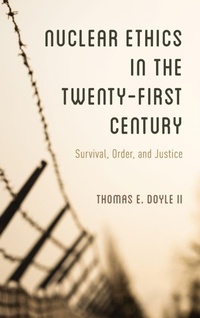
Nuclear Ethics in the Twenty-First Century
Survival, Order, and Justice
Published on 31. January 2020
Book
Hardback
220 pages
978-1-4422-7660-4 (ISBN)
Description
This book relates a complex ethical (re)assessment of the continued reliance by some states on nuclear weapons as instruments of state power. This (re)assessment is more urgent considering the relatively recent intensification of great power conflict dynamics and the nuclear-weapon states' recommitments to modernizing, augmenting, or tailoring their nuclear forces to address vital state and alliance interests. And, especially since the beginning of the administration of U.S. President Donald J. Trump, these recommitments have accelerated the degree to which the political and moral dilemmas of (the threat of) nuclear use define and intensify existential risks for specific states and the international community at large.
To execute this (re)assessment, this book details how strategic, political, legal, and moral reasoning are deeply intertwined on the questions of vital state and global values. Its ontological assumptions are taken from a broadly construed IR Constructivist stance, and its epistemological approach applies non-ideal moral principles informed by Kantian thought to selected problems of nuclear-armed security competition as they evolved since President Barack Obama's 2009 Prague Declaration. This non-ideal moral approach employed is committed to the view that the dual imperatives of humanity's survival and the common security of states requires an international order which privileges considerations of justice over power-political considerations. This non-ideal moral approach is a necessary element of theorizing a set of practices to effectively address the challenges and dilemmas of reordering international politics in terms of justice.
To execute this (re)assessment, this book details how strategic, political, legal, and moral reasoning are deeply intertwined on the questions of vital state and global values. Its ontological assumptions are taken from a broadly construed IR Constructivist stance, and its epistemological approach applies non-ideal moral principles informed by Kantian thought to selected problems of nuclear-armed security competition as they evolved since President Barack Obama's 2009 Prague Declaration. This non-ideal moral approach employed is committed to the view that the dual imperatives of humanity's survival and the common security of states requires an international order which privileges considerations of justice over power-political considerations. This non-ideal moral approach is a necessary element of theorizing a set of practices to effectively address the challenges and dilemmas of reordering international politics in terms of justice.
Reviews / Votes
In this timely and ambitious work, Thomas Doyle combines his twin interests in ethics and nuclear deterrence to good effect. His point of departure is the cold war legacy of "persistent stalemate" between proponents and opponents of nuclear deterrence. Doyle makes a strong case for a new nuclear ethics better aligned with current circumstances, one based on the 1980s concept of "common security." His assertion that stalemate can give way to consensus on this new basis serves as a useful provocation to the needed moral and political debate. -- Brad Roberts, Deputy Assistant Secretary of Defense forNuclear and Missile Defense Policy, 2009-2013 This ambitious and creative book is needed now more than ever. Doyle's riveting development of a nuclear ethics for our time provides a nuanced, interdisciplinary, philosophically-influenced but also pragmatically-grounded achievement for working through one of the most terrifying existential risks of contemporary global politics. This text is essential for courses on international ethics, International Relations, philosophy, and international security. -- Brent J. Steele, Professor and Francis D. Wormuth Presidential Chair, University of Utah As the Bulletin of Atomic Scientists have moved the Doomsday Clock once again close to midnight, Professor Thomas Doyle reexamines the moral questions arising from nuclear weapons. Nuclear Ethics in the Twenty-First Century moves us beyond both the lingering logics of the Cold War, and the shopworn moral philosophies that have guided ethical reflection on the questions concerning the use of nuclear weapons. Taking a cue from the idea of common security, the book offers a new and compelling basis to justify demands for nuclear disarmament in the face of superpower intransigence. -- Harry Gould, Associate Professor of Politics and International Relations, Florida International University Thomas E. Doyle's Nuclear ethics in the twenty-first century is a timely reminder of the existential threat of nuclear war. It makes a compelling case for rethinking nuclear ethics in International Relations through the framework of common security ('security with', rather than 'security against': p. 68). * International Affairs *More details
Language
English
Place of publication
United States
Publishing group
Bloomsbury Publishing Plc
Target group
Professional and scholarly
Illustrations
4 b/w illustrations; 3 tables;
Dimensions
Height: 235 mm
Width: 157 mm
Thickness: 18 mm
Weight
515 gr
ISBN-13
978-1-4422-7660-4 (9781442276604)
Copyright in bibliographic data and cover images is held by Nielsen Book Services Limited or by the publishers or by their respective licensors: all rights reserved.
Schweitzer Classification
Other editions
Additional editions
E-Book
01/2020
1st Edition
Rowman & Littlefield Publishers
€32.99
Available for download
Person
Thomas E. Doyle II is an Associate Professor of Political Science at Texas State University.
Content
Preface
Chapter 1: Introduction: Setting the Agenda
Chapter 2: Cold War Nuclear Ethics: Competing Imperatives and Unresolved Debates
Chapter 3: Nuclear Deterrence and the Moral Imperative of Common Security
Chapter 4: The Ontological and Moral Incoherence of Nuclear-Armed Liberal Democracies
Chapter 5: Morally Responsible Action to Realize the Humanitarian Imperative to Abolish Nuclear Weapons.
Chapter 6: Conclusion: A Nuclear Ethics of Justice, Order, and Survival
Chapter 1: Introduction: Setting the Agenda
Chapter 2: Cold War Nuclear Ethics: Competing Imperatives and Unresolved Debates
Chapter 3: Nuclear Deterrence and the Moral Imperative of Common Security
Chapter 4: The Ontological and Moral Incoherence of Nuclear-Armed Liberal Democracies
Chapter 5: Morally Responsible Action to Realize the Humanitarian Imperative to Abolish Nuclear Weapons.
Chapter 6: Conclusion: A Nuclear Ethics of Justice, Order, and Survival