

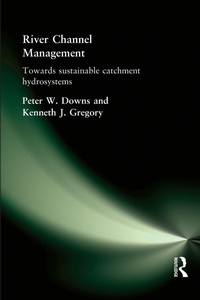
River Channel Management
Towards sustainable catchment hydrosystems
1st Edition
Published on 28. May 2004
Book
Paperback/Softback
408 pages
978-0-340-75969-1 (ISBN)
Description
River Channel Management is the first book to deal comprehensively with recent revolutions in river channel management. It explores the multi-disciplinary nature of river channel management in relation to modern management techniques that bear the background of the entire drainage basin in mind, use channel restoration where appropriate, and are designed to be sustainable.
River Channel Management is divided into five sections:
A?The Introduction outlines the need for river channel management .
A?Retrospective Review offers an overview of twentieth century engineering methods and the ways that river channel systems operate.
A?Realisation explains how greater understanding of river channel adjustments, channel hazards and river basin planning created a context for twenty-first century management.
A?Requirements for Management explains and examines environmental assessment, restoration-based approaches, and methods that work towards 'design with nature'
A?Final Revision speculates about prospects for twenty-first century river channel management.
River Channel Management is written for higher-level undergraduates and for postgraduates in geography, ecology, engineering, planning, geology and environmental science, for professionals involved in river channel management, and for staff in environmental agencies.
River Channel Management is divided into five sections:
A?The Introduction outlines the need for river channel management .
A?Retrospective Review offers an overview of twentieth century engineering methods and the ways that river channel systems operate.
A?Realisation explains how greater understanding of river channel adjustments, channel hazards and river basin planning created a context for twenty-first century management.
A?Requirements for Management explains and examines environmental assessment, restoration-based approaches, and methods that work towards 'design with nature'
A?Final Revision speculates about prospects for twenty-first century river channel management.
River Channel Management is written for higher-level undergraduates and for postgraduates in geography, ecology, engineering, planning, geology and environmental science, for professionals involved in river channel management, and for staff in environmental agencies.
Reviews / Votes
'Excellent coverage of the subject. I have been looking for a book like this for my course for a few years. Very comprehensive.'Ms S Marnolt, University of the West of England
River Channel Management is well researched, well written, thoughful, and provides a comprehensive coverage of the topic.
Richard A. Earl, Journal of Geography # 104
(This) book is an impressive contribution. In all, this is an extremely well written and useful book; my copy is already well dog-eared and worn out from its use.
Dr Martin Doyle, Geomorphology
This book is a welcome addition to the fold that encloses the minority of fluvial geomorphologists who have attempted to 'make a difference' to what they see as a misguided past, dominated by engineering interventions in the interest of river 'training' ... As a final recommendation for this book, the authors have worked within a realization that sustainable river basin management must work within an ecosystem context - and that humans must be considered within that system.
Professor Malcolm Newson, Geographical Journal
More details
Language
English
Place of publication
London
United Kingdom
Publishing group
Taylor & Francis Ltd
Target group
College/higher education
Dimensions
Height: 234 mm
Width: 156 mm
Thickness: 22 mm
Weight
617 gr
ISBN-13
978-0-340-75969-1 (9780340759691)
Copyright in bibliographic data and cover images is held by Nielsen Book Services Limited or by the publishers or by their respective licensors: all rights reserved.
Schweitzer Classification
Other editions
Additional editions
Book
04/2016
1st Edition
Routledge
€254.70
Shipment within 10-20 days
E-Book
02/2014
1st Edition
Routledge
€64.49
Available for download
E-Book
02/2014
1st Edition
Hodder Arnold
€64.49
Available for download
Persons
Dr Peter Downs is currently Senior Fluvial Geomorphologist at Stillwater Sciences, Berkeley, California. He has taught and researched extensively on geomorphological applications to river channel management and restoration.
Professor Ken Gregory is currently Visiting Professor, University of Southampton and Emeritus Professor, University of London. He was awarded the Founders Medal of the Royal Geographical Society for research on river channels. He is the author of Palaeohydrology: Understanding Global Change (Wiley, 2003) and The Changing Nature of Physical Geography (Arnold, 2000).
Professor Ken Gregory is currently Visiting Professor, University of Southampton and Emeritus Professor, University of London. He was awarded the Founders Medal of the Royal Geographical Society for research on river channels. He is the author of Palaeohydrology: Understanding Global Change (Wiley, 2003) and The Changing Nature of Physical Geography (Arnold, 2000).
Content
Part One Introduction
The need for river channel management
Part Two Retrospect
Land use changes conditioning river management
River channel management: early 20th century approaches
Part Three: Realisation
Consequences of river engineering
River channel sensitivity to change
Ecological unity of the river corridor
Integrated river basin planning
Part Four: Requirements
Post-modern river management - river restoration
Environmental assessment in support of river channel management
Environmental aligned river engineering - working with the river
Part Five: Revision
Design with nature: prospects for 21st century river channel management.
The need for river channel management
Part Two Retrospect
Land use changes conditioning river management
River channel management: early 20th century approaches
Part Three: Realisation
Consequences of river engineering
River channel sensitivity to change
Ecological unity of the river corridor
Integrated river basin planning
Part Four: Requirements
Post-modern river management - river restoration
Environmental assessment in support of river channel management
Environmental aligned river engineering - working with the river
Part Five: Revision
Design with nature: prospects for 21st century river channel management.