

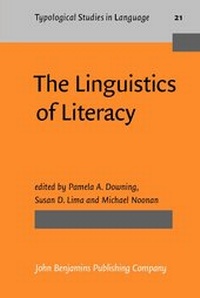
The Linguistics of Literacy
Published on 1. July 1992
Book
Hardback
334 pages
978-90-272-2903-8 (ISBN)
Description
This volume grew out of the Seventeenth Annual University of Wisconsin-Milwaukee Linguistics Symposium, which was held in Milwaukee on April 8-10, 1988. The theme of the conference was the relationship between linguistics and literacy. In this volume, a selection of papers are presented which cluster around three of the major themes that developed during the conference: the linguistic differences between written and spoken genres, the relationship between orthographic systems and phonology, and the psychology of orthography. The volume concludes with a solicited paper by Walter J. Ong which draws together the various strands considered in the other sections of the book and addresses the broader question of the social and psychological consequences of literacy.
More details
Series
Language
English
Place of publication
Amsterdam
Netherlands
Target group
College/higher education
Professional and scholarly
Dimensions
Height: 245 mm
Width: 164 mm
Weight
620 gr
ISBN-13
978-90-272-2903-8 (9789027229038)
Copyright in bibliographic data and cover images is held by Nielsen Book Services Limited or by the publishers or by their respective licensors: all rights reserved.
Schweitzer Classification
Other editions
Additional editions
Pamela A. Downing | Susan D. Lima | Michael Noonan
The Linguistics of Literacy
E-Book
07/1992
1st Edition
John Benjamins Publishing Company
€161.99
Available for download
Content
1. Contributors; 2. Introduction (by Downing, Pamela A.); 3. I. Written Language and poken Language Compared; 4. Variation in the intonation and punctuation of different adverbial clause types in spoken and written English (by Ford, Cecilia E.); 5. Information flow in speaking and writing (by Chafe, Wallace); 6. How is conversation like literary discourse? The role of imagery and details in creating involvement (by Tannen, Deborah); 7. Modern American poetry and modern American speech (by Berry, Eleanor); 8. II. Orthographic systems; 9. Segmentalism in linguisitics: The alphabetic basis of phonological theory (by Aronoff, Mark); 10. The syllabic origin of writing and the segmental origin of the alphabet (by Daniels, Peter T.); 11. Phonemic segmentation as ephiphenomenon: Evidence from the history of alphabetic writing (by Faber, Alice); 12. Aspiration and Cherokee orthographies (by Scancarelli, Janine); 13. Interpreting Emai orthograpgic strategies (by Schaefer, Ronald P.); 14. Linguistic aspects of musical and mathematical notation (by McCawley, James D.); 15. III. The Psychology of Orthography; 16. Orthographic aspects of linguistic competence (by Derwing, Bruce L.); 17. The costs and benefits of phonological analysis (by Ohala, John J.); 18. Morphological relationship revealed through the repetition priming task (by Feldman, Laurie Beth); 19. Orthography and phonology: The psychological reality of orthographic depth (by Frost, Ram); 20. A model of lexical storage: Evidence from second language learners' orthographic errors (by Cowan, J Ron); 21. IV. Consequences of literacy; 22. Writing is a technology that restructures thought (by Ong, Walter J.); 23. Language Index; 24. Author Index; 25. Subject Index