

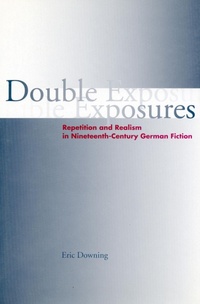
Double Exposures
Repetition and Realism in Nineteenth-Century German Fiction
Published on 1. July 2000
Book
Hardback
352 pages
978-0-8047-3678-7 (ISBN)
Description
Double Exposures aims not only to focus attention on competing meanings of realism and mimesis in nineteenth-century German narrative fiction, but also to supply a quite different account of how realism's typically submerged structures allow readers to explore some of the basic phenomena and contradictions of their extra-literary, social existence. It challenges the currently dominant critical perspective on German poetic realism (and on literary realism in general), which considers this seemingly transparent mode of representation a deeply ideological and self-deceiving form of cultural discourse that reiterates, and so reinforces, powerful social constraints already at work in the extra-literary sphere.
By rethinking the landmark theories of Jacobson and Barthes, Horkheimer and Adorno, and Freud and Lacan-especially their attention to repetition-to point out that any instance of formal repetition produces effects that cannot be contained, the author articulates how the supposedly marginal moments of faltering to both its own and its other cultural discourses are, in fact, intrinsic effects of poetic realism's double, conflictual nature.
Through a series of close readings of several realist novellas by Adalbert Stifter, Gottfried Keller, Theodor Storm, C. F. Meyer, and Wilhelm Raabe, the book explores a number of realism's array of "redundant" motifs having to do with nature, gender, family, class, and aesthetics. It demonstrates that the realist project was always about more than simply reinforcing bourgeois ideology, and always fostered a form of self-awareness and reflection inseparable from what we value as literature.
By rethinking the landmark theories of Jacobson and Barthes, Horkheimer and Adorno, and Freud and Lacan-especially their attention to repetition-to point out that any instance of formal repetition produces effects that cannot be contained, the author articulates how the supposedly marginal moments of faltering to both its own and its other cultural discourses are, in fact, intrinsic effects of poetic realism's double, conflictual nature.
Through a series of close readings of several realist novellas by Adalbert Stifter, Gottfried Keller, Theodor Storm, C. F. Meyer, and Wilhelm Raabe, the book explores a number of realism's array of "redundant" motifs having to do with nature, gender, family, class, and aesthetics. It demonstrates that the realist project was always about more than simply reinforcing bourgeois ideology, and always fostered a form of self-awareness and reflection inseparable from what we value as literature.
Reviews / Votes
"Downing's highly original, thorough, and rewarding book is certain to emerge as an indispensable critical reference-point for scholars and students in the areas of narrative theory, problems of realism, and 19th-century German prose. . . . A nearly ideal combination of intellectual scope, erudition, and originality." -Thomas Pfau, Duke University "To write an engaging and entertaining study of German or poetic realism that offers insightful and differentiated readings of the novellas of Stifter, Storm, Keller, C.F. Meyer, and Raabe through the lenses-focused on repetition-of narratology, Critical Theory, and psychoanalysis and, to a leser extent gender studies, is without a doubt a daunting endeavor. This study, with its keen analysis of the doubling within German realist texts, is equal to the task. . . . While this book is written to engage and challenge scholars of realism, the clarity of Downing's prose makes the textual twists and turns, and thus the study as a whole, equally accessible to non-specialists."-German Studies Review "Downing's readings are persuasive and well documented; the research is usually meticulous and his erudition considerable. . . . There is no question about the high quality of Downing's contributions to our understanding of the complicated and contradictory strategies of German literary realism in the nineteenth century."-MonatshefteMore details
Edition
New edition
Language
English
Place of publication
Palo Alto
United States
Target group
College/higher education
Professional and scholarly
Edition type
New edition
Product notice
Cloth
Dimensions
Height: 235 mm
Width: 162 mm
Thickness: 26 mm
Weight
621 gr
ISBN-13
978-0-8047-3678-7 (9780804736787)
Copyright in bibliographic data and cover images is held by Nielsen Book Services Limited or by the publishers or by their respective licensors: all rights reserved.
Schweitzer Classification
Person
Eric Downing is Associate Professor of Comparative Literature at the University of North Carolina, Chapel Hill. He is the author of Artificial I's: The Self as Artwork in Ovid, Kierkegaard, and Thomas Mann.
Content
1. Theoretical introduction: repetition and realism in narratology, critical theory, and psychoanalysis; 2. Real and recurrent problems: Stifter's preface to Many-Colored Stones (Bunte Steine); 3. Double visions: chiastic mimesis and the politics of realism in Stifter's The Mountain Forest (Der Hochwald); 4. Double takes: genre and gender in Keller's twice-told tales, the Seven Legends (Sieben Legenden); 5. Second wives, second lives: the 'ligeia impulse' in Theodor Storm's Viola tricolor; 6. Double-dealings: trading places in Meyer's The Marriage of the Monk (Die Hochzeit des Monchs); 7. Secondhand news: boredom and a motive for murder in Wilhelm Raabe's Fatso (Stopfkuchen); 8. (In) conclusion: second thoughts; Notes; Index.