

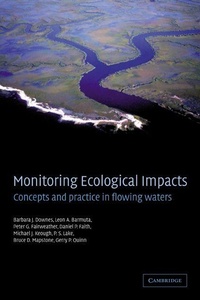
Monitoring Ecological Impacts
Concepts and Practice in Flowing Waters
Published on 12. June 2008
Book
Paperback/Softback
452 pages
978-0-521-06529-0 (ISBN)
Description
Monitoring Ecological Impacts provides the tools needed by professional ecologists, scientists, engineers, planners and managers to design assessment programs that can reliably monitor, detect and allow management of human impacts on the natural environment. The procedures described are well grounded in inferential logic, and the statistical models needed to analyse complex data are given. Step-by-step guidelines and flow diagrams provide the reader with clear and useable protocols, which can be applied in any region of the world and to a wide range of human impacts. In addition, real examples are used to show how the theory can be put into practice. Although the context of this book is flowing water environments, especially rivers and streams, the advice for designing assessment programs can be applied to any ecosystem.
Reviews / Votes
Review of the hardback: ' ... of value particularly to consultants and others involved in ecological monitoring related to waste or other major developments.' Mineral PlanningMore details
Language
English
Place of publication
Cambridge
United Kingdom
Target group
Professional and scholarly
Product notice
Paperback (trade)
Illustrations
36 Tables, unspecified; 37 Line drawings, unspecified
Dimensions
Height: 229 mm
Width: 152 mm
Thickness: 26 mm
Weight
729 gr
ISBN-13
978-0-521-06529-0 (9780521065290)
Copyright in bibliographic data and cover images is held by Nielsen Book Services Limited or by the publishers or by their respective licensors: all rights reserved.
Schweitzer Classification
Other editions
Additional editions
Barbara J. Downes | Leon A. Barmuta | Peter G. Fairweather
Monitoring Ecological Impacts
Concepts and Practice in Flowing Waters
E-Book
01/2005
1st Edition
Cambridge University Press
€61.99
Available for download
Persons
Barbara J. Downes is a Senior Lecturer in Ecology in the Department of Geography and Environmental Studies at the University of Melbourne, Australia. She is an aquatic ecologist, with 20 years research experience in both freshwater and marine environments. Leon A. Barmuta is a Lecturer in Zoology at the University of Tasmania, Australia. He is a freshwater ecologist with extensive experience in basic and applied ecology in Australia and the United States of America. Peter Fairweather is a Senior Lecturer in Ecology at Deakin University, Australia. He has worked in marine, estuarine and freshwater ecosystems in Australia and USA, and has edited the Australian Journal of Ecology. Daniel Faith is a Principal Research Scientist at the Australian Museum, with research interests in systematics, biodiversity conservation and biological monitoring. He is an Associate Editor of Systematic Biology. Michael Keough is a Reader in Zoology at the University of Melbourne. His research interests include the ecology of natural and human-induced disturbances in coastal habitats. He is co-author of Experimental Design and Data Analysis for Biologists, Cambridge University Press, 2002. P. S. Lake is Professor in Ecology at Monash University, Australia. He is currently Chief Ecologist in the Cooperative Research Centre for Freshwater Ecology.
Content
Part I. Introduction to the Nature of Monitoring Problems and to Rivers: 1. Why we need well-designed monitoring programs; 2. The ecological nature of flowing waters; 3. Assessment of perturbation; Part II. Principles of Inference and Design: 4. Inferential issues for monitoring; 5. The logical bases of monitoring design; 6. Problems in applying designs; 7. Alternative models for impact assessment; Part III. Applying Principles of Inference and Design: 8. Applying monitoring designs to flowing waters; 9. Inferential uncertainty and multiple lines of evidence; 10. Variables that are used for monitoring in flowing waters; 11. Defining important changes; 12. Decisions and trade-offs; 13. Optimization; 14. The special case of monitoring attempts at restoration; 15. What's next?