

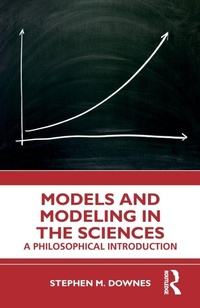
Models and Modeling in the Sciences
A Philosophical Introduction
1st Edition
Published on 10. July 2020
Book
Paperback/Softback
104 pages
978-1-138-12223-9 (ISBN)
Description
Biologists, climate scientists, and economists all rely on models to move their work forward. In this book, Stephen M. Downes explores the use of models in these and other fields to introduce readers to the various philosophical issues that arise in scientific modeling. Readers learn that paying attention to models plays a crucial role in appraising scientific work.
This book first presents a wide range of models from a number of different scientific disciplines. After assembling some illustrative examples, Downes demonstrates how models shed light on many perennial issues in philosophy of science and in philosophy in general. Reviewing the range of views on how models represent their targets introduces readers to the key issues in debates on representation, not only in science but in the arts as well. Also, standard epistemological questions are cast in new and interesting ways when readers confront the question, "What makes for a good (or bad) model?"
All examples from the sciences and positions in the philosophy of science are presented in an accessible manner. The book is suitable for undergraduates with minimal experience in philosophy and an introductory undergraduate experience in science.
Key features:
The book serves as a highly accessible philosophical introduction to models and modeling in the sciences, presenting all philosophical and scientific issues in a nontechnical manner.
Students and other readers learn to practice philosophy of science by starting with clear examples taken directly from the sciences.
While not comprehensive, this book introduces the reader to a wide range of views on key issues in the philosophy of science.
This book first presents a wide range of models from a number of different scientific disciplines. After assembling some illustrative examples, Downes demonstrates how models shed light on many perennial issues in philosophy of science and in philosophy in general. Reviewing the range of views on how models represent their targets introduces readers to the key issues in debates on representation, not only in science but in the arts as well. Also, standard epistemological questions are cast in new and interesting ways when readers confront the question, "What makes for a good (or bad) model?"
All examples from the sciences and positions in the philosophy of science are presented in an accessible manner. The book is suitable for undergraduates with minimal experience in philosophy and an introductory undergraduate experience in science.
Key features:
The book serves as a highly accessible philosophical introduction to models and modeling in the sciences, presenting all philosophical and scientific issues in a nontechnical manner.
Students and other readers learn to practice philosophy of science by starting with clear examples taken directly from the sciences.
While not comprehensive, this book introduces the reader to a wide range of views on key issues in the philosophy of science.
Reviews / Votes
CHOICE Highly Recommended:"In this short but thorough and informative work, Downes provides a detailed, judicious overview of the nature of scientific models as fundamental components of the sciences and of the processes of modeling as an essential aspect of scientific practice. As part of elucidating the depth and range of models and modeling, Downes provides examples and types of models across multiple disciplines, including biology, physics, psychology, and economics. . . . Summing up: Highly recommended. Lower- and upper-division undergraduates. Graduate students, faculty, and professionals. Students in two-year technical programs."
D. B. Boersema (Pacific University) in Choice
Reprinted with permission from CHOICE http://www.choicereviews.org, copyright by the American Library Association
More details
Language
English
Place of publication
London
United Kingdom
Publishing group
Taylor & Francis Ltd
Target group
College/higher education
Illustrations
30 s/w Abbildungen, 3 s/w Photographien bzw. Rasterbilder, 27 s/w Zeichnungen, 1 s/w Tabelle
1 Tables, black and white; 27 Line drawings, black and white; 3 Halftones, black and white; 30 Illustrations, black and white
Dimensions
Height: 198 mm
Width: 129 mm
Thickness: 7 mm
Weight
133 gr
ISBN-13
978-1-138-12223-9 (9781138122239)
Copyright in bibliographic data and cover images is held by Nielsen Book Services Limited or by the publishers or by their respective licensors: all rights reserved.
Schweitzer Classification
Other editions
Additional editions

Book
07/2020
1st Edition
Routledge
€230.27
Shipment within 10-20 days
E-Book
07/2020
1st Edition
Routledge
€55.49
Available for download
E-Book
07/2020
1st Edition
Routledge
€55.49
Available for download
Person
Stephen M. Downes is Professor of Philosophy at the University of Utah, USA. He has published articles on the philosophy of biology, the biology of human behavior, and scientific models. He is co-editor, with Edouard Machery, of Arguing about Human Nature (Routledge, 2013).
Content
Preface 1. Introduction 2. Models in the Sciences 3. Characterizing and Classifying Models 4. Models and Representation 5. What Makes for a Good (or Bad) Model? 6. Conclusion: Pluralism about Models, Modeling, and Model Evaluation