

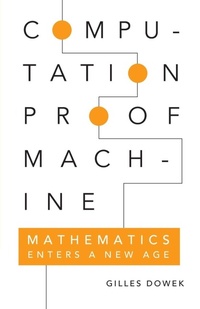
Computation, Proof, Machine
Mathematics Enters a New Age
Published on 5. May 2015
Book
Paperback/Softback
160 pages
978-0-521-13377-7 (ISBN)
Description
Computation is revolutionizing our world, even the inner world of the 'pure' mathematician. Mathematical methods - especially the notion of proof - that have their roots in classical antiquity have seen a radical transformation since the 1970s, as successive advances have challenged the priority of reason over computation. Like many revolutions, this one comes from within. Computation, calculation, algorithms - all have played an important role in mathematical progress from the beginning - but behind the scenes, their contribution was obscured in the enduring mathematical literature. To understand the future of mathematics, this fascinating book returns to its past, tracing the hidden history that follows the thread of computation. Along the way it invites us to reconsider the dialog between mathematics and the natural sciences, as well as the relationship between mathematics and computer science. It also sheds new light on philosophical concepts, such as the notions of analytic and synthetic judgment. Finally, it brings us to the brink of the new age, in which machine intelligence offers new ways of solving mathematical problems previously inaccessible. This book is the 2007 winner of the Grand Prix de Philosophie de l'Academie Francaise.
Reviews / Votes
'In this pithy, award-winning account of the growing role of computation in mathematics, Gilles Dowek adds further evidence, if any were needed, that the Age of the Algorithm is upon us. A master storyteller, the author takes the reader on an exhilarating journey through the history of mathematics, as he explains, in engaging, vivid prose, why to prove is to compute. A delightful read brimming with big ideas.' Bernard Chazelle, Princeton University 'An engaging study of the history of computing told from a distinctive perspective. Gilles Dowek examines the traditional axiomatic conception of mathematical proof and argues that the advent of computer-assisted proofs (for example the Appel-Haken proof of the four color theorem, the proof of Hale's theorem) and the recent development of the proofs-as-programs idea together lead the way to a new conception of proof, one in which computation rather than logical reasoning plays the dominant role. The result is an illuminating challenge to one of the firmest orthodoxies in the foundations of mathematics.' Michael Detlefsen, University of Notre Dame 'Dowek's book is a superb overview of the transformation of mathematics toward becoming a computational science. It is historically rich, philosophically inquisitive and mathematically rigorous.' Andrew Arana, MetascienceMore details
Language
English
Place of publication
Cambridge
United Kingdom
Target group
Professional and scholarly
Product notice
Paperback (trade)
Illustrations
6 Line drawings, unspecified
Dimensions
Height: 216 mm
Width: 140 mm
Thickness: 9 mm
Weight
213 gr
ISBN-13
978-0-521-13377-7 (9780521133777)
Copyright in bibliographic data and cover images is held by Nielsen Book Services Limited or by the publishers or by their respective licensors: all rights reserved.
Schweitzer Classification
Other editions
Additional editions
Book
05/2015
Cambridge University Press
€113.30
Shipment within 15-20 days
Persons
Gilles Dowek is a mathematician, logician and computer scientist, and currently a researcher at the French Institute for Research in Computer Science and Automation (INRIA). He is a member of the scientific board of the Societe informatique de France and of CERNA. He is also a consultant with the National Institute of Aerospace, a NASA-affiliated laboratory. He is the recipient of the French Mathematical Society's Grand Prix d'Alembert des Lyceens for his popular science work. Pierre Guillot is a lecturer in Mathematics at the University of Strasbourg's Institute of Advanced Mathematical Research (IRMA). Marion Roman is a France-based translator.
Content
Part I. Ancient Origins: 1. From the prehistory to the Greeks; 2. Two thousand years of computation; Part II. The Age of Reason: 3. Predicate logic; 4. The decision problem; 5. Church's thesis; 6. Lambda-calculus; 7. Constructivity; 8. Constructive proofs and algorithms; Part III. Crisis of the Axiomatic Method: 9. Intuitionistic type theory; 10. Automated proof; 11. Automated proof checking; 12. News from the field; 13. Instruments; 14. The end of axioms?; 15. Conclusion: as we near the end of this mathematical voyage.