

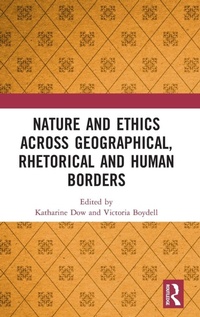
Nature and Ethics Across Geographical, Rhetorical and Human Borders
1st Edition
Published on 6. February 2018
Book
Hardback
118 pages
978-1-138-57190-7 (ISBN)
Description
How we dispose of our rubbish, choose the foods we buy, enjoy art, relate to our families, and think about ourselves are just a few of the ways that ideas about nature shape our everyday ethical decisions. Nature and 'natural facts' have long been used to make sense of why we act a certain way. Nature is a concept with great power: when we describe something as 'natural' or 'unnatural', it has a moral force and political consequences. We see this in moral panics about genetically modified foods, the spread of government-enforced waste recycling schemes, concerns about assisted reproductive technologies. Our ideas about what is natural shape our ethical thinking, in terms of how people live (or want to live) their lives, but also in guiding our sense of morality, justice and truth.
The idea of naturalness is essential to grasping Anglo-American cultures. Throughout history and in different places, nature has had different forms, meanings, and moral valences. It is a knowable fact, but at the same time almost a divine principle that is ultimately unfathomable. Yet with the rise of new technologies, there is increasing uncertainty about what we claim to be natural, who we are, how we are related to each other, and how we should live.
This book examines the how ideas about nature and ethics overlap and separate across cultural, species, geographic, and moral boundaries. It compares the varied ways in which nature and ideas of naturalness pervade all aspects of people's lives, from family relationships, to the production and consumption of food, to ideas about scientific truth. In a world of increasing uncertainty, nature remains a powerful concept: the ultimate reference point, invested with profound moral authority to guide our ethical behaviour. This book was originally published as a special issue of Ethnos.
The idea of naturalness is essential to grasping Anglo-American cultures. Throughout history and in different places, nature has had different forms, meanings, and moral valences. It is a knowable fact, but at the same time almost a divine principle that is ultimately unfathomable. Yet with the rise of new technologies, there is increasing uncertainty about what we claim to be natural, who we are, how we are related to each other, and how we should live.
This book examines the how ideas about nature and ethics overlap and separate across cultural, species, geographic, and moral boundaries. It compares the varied ways in which nature and ideas of naturalness pervade all aspects of people's lives, from family relationships, to the production and consumption of food, to ideas about scientific truth. In a world of increasing uncertainty, nature remains a powerful concept: the ultimate reference point, invested with profound moral authority to guide our ethical behaviour. This book was originally published as a special issue of Ethnos.
More details
Language
English
Place of publication
London
United Kingdom
Publishing group
Taylor & Francis Ltd
Target group
College/higher education
Dimensions
Height: 240 mm
Width: 161 mm
Thickness: 12 mm
Weight
367 gr
ISBN-13
978-1-138-57190-7 (9781138571907)
Copyright in bibliographic data and cover images is held by Nielsen Book Services Limited or by the publishers or by their respective licensors: all rights reserved.
Schweitzer Classification
Other editions
Additional editions
Katharine Dow | Victoria Boydell
Nature and Ethics Across Geographical, Rhetorical and Human Borders
Book
08/2020
1st Edition
Routledge
€64.50
Shipment within 15-20 days
Katharine Dow | Victoria Boydell
Nature and Ethics Across Geographical, Rhetorical and Human Borders
E-Book
10/2019
1st Edition
Routledge
€59.49
Available for download
Katharine Dow | Victoria Boydell
Nature and Ethics Across Geographical, Rhetorical and Human Borders
E-Book
10/2019
1st Edition
Routledge
€59.49
Available for download
Persons
Katharine Dow is a senior research associate in the Reproductive Sociology Research Group at the University of Cambridge, UK. Her main research interest is the ethical dilemmas and questions provoked by reproduction and assisted reproductive technologies
Victoria Boydell is an Affiliated Scholar in the Reproductive Sociology Research Group at the University of Cambridge, UK. Her main research interest is social and cultural dynamics around contraceptive technologies.
Victoria Boydell is an Affiliated Scholar in the Reproductive Sociology Research Group at the University of Cambridge, UK. Her main research interest is social and cultural dynamics around contraceptive technologies.
Content
Introduction: Nature and Ethics Across Geographical, Rhetorical and Human Borders 1. 'Natural' Breastfeeding in Comparative Perspective: Feminism, Morality, and Adaptive Accountability 2. The Ethics of Patenting and Genetically Engineering the Relative Haloa 3. Snared: Ethics and Nature in Animal Protection 4. 'A Nine-Month Head-Start': The Maternal Bond and Surrogacy 5. A Response to the Issues Raised in the Special Edition of Ethnos