

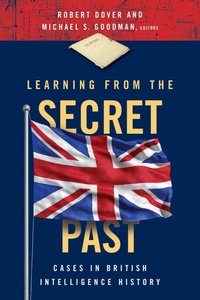
Learning from the Secret Past
Cases in British Intelligence History
Published on 4. November 2011
Book
Paperback/Softback
288 pages
978-1-58901-770-2 (ISBN)
Description
Identifying "lessons learned" is not new - the military has been doing it for decades. However, members of the worldwide intelligence community have been slow to extract wider lessons gathered from the past and apply them to contemporary challenges. "Learning from the Secret Past" is a collection of ten carefully selected cases from post-World War II British intelligence history. Some of the cases include the Malayan Emergency, the Cuban Missile Crisis, Northern Ireland, and the lead up to the Iraq War. Each case, accompanied by authentic documents, illuminates important lessons that today's intelligence officers and policymakers - in Britain and elsewhere - should heed. Written by former and current intelligence officers, high-ranking government officials, and scholars, the case studies in this book detail intelligence successes and failures, discuss effective structuring of the intelligence community, examine the effective use of intelligence in counterinsurgency, explore the ethical dilemmas and practical gains of interrogation, and highlight the value of human intelligence and the dangers of the politicization of intelligence.
The lessons learned from this book stress the value of past experience and point the way toward running effective intelligence agencies in a democratic society. Scholars and professionals worldwide who specialize in intelligence, defense and security studies, and international relations will find this book to be extremely valuable.
The lessons learned from this book stress the value of past experience and point the way toward running effective intelligence agencies in a democratic society. Scholars and professionals worldwide who specialize in intelligence, defense and security studies, and international relations will find this book to be extremely valuable.
Reviews / Votes
The range of documents throughout the volume is impressive, including a parliamentary debate, Joint Intelligence Committee reports, a transcription of a secret meeting between agents and a military directive. By integrating these fascinating sources with perceptive historical analysis, this book makes a strong case for the desirability of studying the past. International Affairs This is a book that any serious student of British intelligence activity will want to read and read again. British Politics Group Newsletter Dover and Goodman have made a substantial and timely contribution to the American and British intelligence communities on aspects of the importance of creating a process to identify lessons learned, similar to the process used by the military, in spite of the difficulty of drawing lessons from intelligence because most successes go unreported due to the nature of the trade, and failures are analyzed by outsiders who must judge what they are not allowed to observe. International Journal of Intelligence EthicsMore details
Language
English
Place of publication
Washington, DC
United States
Target group
Professional and scholarly
US School Grade: College Graduate Student and over
Product notice
Paperback (trade)
Illustrations
Not illustrated
Dimensions
Height: 229 mm
Width: 152 mm
Thickness: 19 mm
Weight
487 gr
ISBN-13
978-1-58901-770-2 (9781589017702)
Copyright in bibliographic data and cover images is held by Nielsen Book Services Limited or by the publishers or by their respective licensors: all rights reserved.
Schweitzer Classification
Other editions
Additional editions
Robert Dover | Michael S. Goodman
Learning from the Secret Past
Cases in British Intelligence History
E-Book
11/2011
Georgetown University Press
€58.49
Available for download
Persons
Robert Dover is a senior lecturer in international relations at Loughborough University (UK) and the author of The Europeanization of British Defence Policy, 1997-2005. Michael S. Goodman is a senior lecturer in the Department of War Studies at King's College London, official historian of the Joint Intelligence Committee (UK), and author of Spying on the Nuclear Bear: Anglo-American Intelligence and the Soviet Bomb.
Content
Preface Learning from the Secret PastDavid Omand Part I: The Organization and Oversight of Intelligence1. The Post-War Organization of Intelligence: The January 1945 Report to the Joint Intelligence Committee on "The Intelligence Machine"Michael Herman Document: The Intelligence Machine 2. "A Formidable Power to Cause Trouble for the Government"? Intelligence Oversight and the Creation of the UK Intelligence and Security CommitteePeter Gill Document: Intelligence Services Bill Part II: Political Interference in Intelligence 3. The Scott Report: Intelligence and the Arms TradeRobert Dover Document: Matrix Churchill Ltd: Export Licence Applications for Iraq, September 25, 1989 4. Political Interference in the Intelligence Process: The Case of Iraqi WMDMark Phythian Document: The Butler Report: Annex B: Intelligence Assessment and Presentation: From March to September 2002 Part III: Counterinsurgency and Counterterrorism5. Intelligence and Counterinsurgency: The Malayan ExperienceMatthew Jones Document: "The Special Branch Charter," Directive No. 21, Director of Operations, Malaya, 24th April 1952 6. "A Skeleton in Our Cupboard": British Interrogation Procedures in Northern IrelandRichard J. Aldrich Document6: Prisoner Handling in Interrogation Centres in Northern Ireland: Report by the Intelligence Coordinator 7. The Value and Limits of Experience in the Early Years of the Northern Ireland Troubles, 1969-1972Eunan O'Halpin Document: Visit by Secretary JIC to Northern Ireland, January 10-12, 1972 Part IV: Avoiding Surprise 8. Suez and the Threat to UK Interests OverseasGill Bennett Document: The Threat to United Kingdom Interests Overseas, October 18, 1956 9. Oleg Penkovsky, British Intelligence, and the Cuban Missile CrisisLen Scott Document: "Cuba: Threat Posed By Soviet Missiles," October 26, 1962 Document: CIA Memo: Meeting No. 1 (London) at Mount Royal Hotel, April 20, 1961 10. Avoiding Surprise: The Nicoll Report and Intelligence AnalysisMichael S. Goodman Document: "The Joint Intelligence Committee and Warning of Aggression," November 1981 11. Lessons Learned: What the History of British Intelligence Can Tell Us about the FutureRobert Dover and Michael S. GoodmanContributors Index