

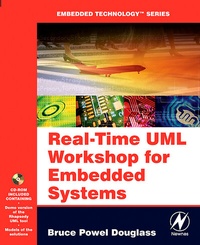
Real Time UML Workshop for Embedded Systems
Published on 19. October 2006
Book
Paperback/Softback
432 pages
978-0-7506-7906-0 (ISBN)
Description
This practical new book provides much-needed, practical, hands-on experience capturing analysis and design in UML. It holds the hands of engineers making the difficult leap from developing in C to the higher-level and more robust Unified Modeling Language, thereby supporting professional development for engineers looking to broaden their skill-sets in order to become more saleable in the job market. It provides a laboratory environment through a series of progressively more complex exercises that act as building blocks, illustrating the various aspects of UML and its application to real-time and embedded systems. With its focus on gaining proficiency, it goes a significant step beyond basic UML overviews, providing both comprehensive methodology and the best level of supporting exercises available on the market. Each exercise has a matching solution which is thoroughly explained step-by-step in the back of the book. The techniques used to solve these problems come from the author's decades of experience designing and constructing real-time systems. After the exercises have been successfully completed, the book will act as a desk reference for engineers, reminding them of how many of the problems they face in their designs can be solved.
Reviews / Votes
"As you might expect, there are plenty of UML diagrams. Real-time UML specifications are used throughout, consistent with the purpose of the book. Designers with UML expertise who want to understand how to address real-time applications will find this book useful, as will those in the real-time world who need to understand how to bring UML to bear on the design problem." --William Wong, Electronic DesignMore details
Series
Language
English
Place of publication
Oxford
United Kingdom
Publishing group
Elsevier Science & Technology
Target group
Professional and scholarly
PRIMARY MARKET: Embedded Design Engineers, Electrical Engineers, Computer Engineers, Software Engineers , System Engineers, System Architects
SECONDARY MARKET: Upper-level undergrad and post-graduate level electrical and computer engineering students
Illustrations
Approx. 270 illustrations
Dimensions
Height: 235 mm
Width: 191 mm
Weight
903 gr
ISBN-13
978-0-7506-7906-0 (9780750679060)
Copyright in bibliographic data and cover images is held by Nielsen Book Services Limited or by the publishers or by their respective licensors: all rights reserved.
Schweitzer Classification
Other editions
New editions
Bruce Powel Douglass
Real-Time UML Workshop for Embedded Systems
Book
04/2014
2nd Edition
Newnes
€63.13
Article exhausted; check different version
Additional editions
Bruce Powel Douglass
Real Time UML Workshop for Embedded Systems
E-Book
04/2011
Elsevier
€50.95
Available for download
Person
Embedded Software Methodologist. Triathlete. Systems engineer. Contributor to UML and SysML specifications. Writer. Black Belt. Neuroscientist. Classical guitarist. High school dropout. Bruce Powel Douglass, who has a doctorate in neurocybernetics from the USD Medical School, has over 35 years of experience developing safety-critical real-time applications in a variety of hard real-time environments. He is the author of over 5700 book pages from a number of technical books including Real-Time UML, Real-Time UML Workshop for Embedded Systems, Real-Time Design Patterns, Doing Hard Time, Real-Time Agility, and Design Patterns for Embedded Systems in C. He is the Chief Evangelist at IBM Rational, where he is a thought leader in the systems space and consulting with and mentors IBM customers all over the world.
Content
Part I: Basics and Preliminaries; Ch1: Basic UML Introduction: Use Cases and Requirements; Ch 2: The ROPES Process: Project Lifecycles; Part II: Exercises; Ch 3: Specifying the Requirements: Grouping Requirements; Ch 4: Systems Architecture: Performing Tradeoff Analysis for Different Architectures; Ch 5 Object Analysis: Applying Object Identification Strategies; Ch 6: Concurrency Architecture: Identifying Tasks; Ch 7: Distribution Architecture: Asymmetric and Symmetric Distribution; Ch 8: Safety and Reliability Architecture: Identifying Channels; Ch 9: Optimizing Collaborations: Reusability, Data Access, Complexity; Ch 10: Detailed Design: Managing Visibility and Access; Part III: Answers; Appendix A: Notational Summary; Appendix B: Short Rhapsody Tutorial.